Considerations and Implications
The Configuration Externalization Pattern works by pulling a service's settings out of its deployable artifact and into a network-accessible configuration server, so that at startup (and on demand afterwards) each service fetches its properties over HTTP instead of reading a file baked into its own image. That single move — turning configuration from a local file read into a remote call — is what buys you central management and dynamic refresh, and it is also the root of every consideration below: you have added a network dependency, a shared piece of state, and a cache to the critical path of every service boot.
A worked startup, step by step
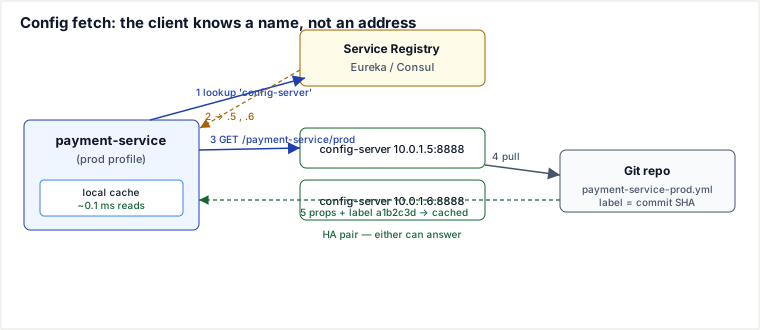
Follow one instance of payment-service booting in the prod profile against a Spring Cloud Config server backed by Git, discovered through Eureka. The service does not know the config server's IP — it only knows its logical name. Real values and representative latencies:
| # | Step | Concrete value | Latency |
|---|---|---|---|
| 1 | Read local bootstrap.yml | spring.application.name=payment-service, discovery.enabled=true, config server id config-server | <1 ms |
| 2 | Ask the registry to resolve config-server | Eureka returns two instances: 10.0.1.5:8888, 10.0.1.6:8888 | ~8 ms |
| 3 | Client picks an instance, calls it | GET http://10.0.1.5:8888/payment-service/prod | network 3 ms |
| 4 | Server resolves the source | Git pull of config-repo, read payment-service-prod.yml + application.yml, merge | 110 ms cold, 4 ms warm |
| 5 | Server returns a labelled property source | JSON with label = a1b2c3d (the commit SHA), db.pool.size=40, feature.newCheckout=true | — |
| 6 | Client binds properties & caches them in memory | Subsequent reads are local map lookups | ~0.1 ms |
Total first-boot config cost: roughly 120 ms — paid once. When a firewall change to a listed database secret is committed, the operator posts to /actuator/busrefresh; Spring Cloud Bus fans the event out over the message broker and every client re-runs steps 3–6, so the fleet picks up label a1b2c3d → e4f5g6h in seconds without a redeploy. That refresh path is the whole reason to accept the network dependency.
The five considerations, made concrete
Data security — a new attack surface
Config now travels the network and lives outside the artifact, so both hops must be defended: TLS on the client→server call (step 3) and encryption at rest for secrets. Spring Cloud Config lets you store {cipher}... values that the server decrypts with a symmetric or RSA key; better still, keep raw secrets in a dedicated store (Vault, AWS Secrets Manager) and let config serve only non-secret settings plus references. Rotate keys on a schedule — a leaked config-server signing key exposes every secret it ever encrypted.
The config server as a single point of failure
If the only config server is down when 30 pods restart during a deploy, none of them can complete step 3 and the whole fleet fails to boot. Mitigate with an HA pair (or three) behind the registry, liveness/readiness probes so a wedged instance is pulled from rotation, and a client-side fallback: keep the last-known-good config on local disk so a service can start degraded even if the server is briefly unreachable.
Versioning and rollback via Git
Because the backing store is Git, the returned label is a commit SHA — every config state is a commit you can git revert. A bad db.pool.size=4000 that exhausts connections is rolled back by reverting the commit and firing one bus refresh, no image rebuild. This only holds if you enforce discipline: reviewed PRs, one setting per commit where it matters, and profiles (-prod, -staging) kept in separate files.
Bootstrapping the config server's own location
The chicken-and-egg problem: the client needs config to run, but the config server's address is itself config. Hardcoding 10.0.1.5:8888 in 50 services means a re-deploy of all 50 when that IP changes. The fix is discovery-first bootstrap (steps 1–2): the client only hardcodes the registry location and the logical name config-server, then resolves the real endpoints at runtime.
Caching — latency vs. freshness
The in-memory cache turns 120 ms fetches into 0.1 ms reads, but it means a value can be stale between refreshes. This is the core tuning knob. Pure event-driven refresh (bus on commit) gives near-zero staleness but couples you to a healthy broker; a periodic poll (say every 30 s) bounds staleness to the interval at the cost of steady load on the server. Pick based on how fast a config change must propagate versus how much request traffic you can spend re-fetching.
Pitfalls
- Boot ordering deadlock. Config server, registry, and message broker all depend on each other at cold start; bring the whole platform up and everything blocks on everything. Give the config server a self-contained bootstrap (native profile / local files) so it never needs the very services that need it.
- Refresh only reloads
@RefreshScopebeans. A changedserver.portor a datasource URL captured at construction time will not take effect on/actuator/refresh— it silently keeps the old value until a full restart. Engineers assume the whole app re-read its config; it did not. - Secrets in plaintext Git history. Committing a raw password then "fixing" it in a later commit leaves it forever in history. Encrypt before commit or never let secrets touch the config repo.
- Thundering herd on refresh. A bus event that makes 200 clients re-fetch in the same 100 ms window can overwhelm a single cold config server (Git pull under load). Jitter the refresh or scale the server tier.
- Stale cache masking a rollback. You revert a bad commit but forget the refresh trigger; clients keep serving the broken value from cache and the "rollback" appears to do nothing.
When to use a config server — and when not to
Reach for a centralized config server when you run many services that share settings, need to change configuration without a redeploy, want a Git audit trail and one-command rollback, and your fleet is polyglot or spread across heterogeneous infrastructure (VMs + containers + on-prem). Those signals are exactly what it is good at.
Trade-offs versus named alternatives:
- Baked-in / immutable config (settings compiled into the image): you gain zero runtime dependencies and perfectly reproducible deploys, but any change costs a full rebuild + rolling redeploy. Prefer this when config is essentially static and you value immutability over dynamism.
- Environment variables / 12-factor: dead simple, no network on the critical path, works everywhere — but changing a value requires a restart, there is no dynamic refresh, no version history, and secrets are visible in the process environment. Prefer this for small deployments or a handful of services.
- Kubernetes ConfigMaps + Secrets: native to the platform, mounted as files or env, and volume-mounted keys can hot-reload without a config server at all. If you are all-in on Kubernetes, this often makes a separate config server redundant. The config server wins when you are not uniformly on k8s, or need Git-backed history and cross-platform bus refresh that ConfigMaps don't give you.
Decision rule: choose a config server when dynamic, audited, cross-platform config outweighs the cost of a new network dependency and cache; prefer ConfigMaps/Secrets when the whole fleet lives in one Kubernetes cluster; prefer plain env vars when a restart-to-change is acceptable and the service count is small.
Takeaways
- Externalizing config trades a local file read for a remote call — that one change is the source of both the benefits (central management, dynamic refresh) and every risk (SPOF, cache staleness, boot-order coupling).
- Never let the config server be a single instance or a single point of boot-time dependency: HA pair, health probes, discovery-based bootstrap, and a local last-known-good fallback.
- The cache is a latency/freshness dial: event-driven refresh minimizes staleness, periodic polling bounds it — tune to how fast changes must propagate.
- Git backing gives you versioned rollback for free, but only with reviewed changes, encrypted secrets, and a reliable refresh trigger.
Sources: Chris Richardson, Microservices Patterns (Manning) — Externalized Configuration; the Spring Cloud Config reference documentation (config server, @RefreshScope, Spring Cloud Bus / busrefresh); Netflix Eureka and HashiCorp Consul service-discovery docs; and the Twelve-Factor App methodology (Factor III, Config). Re-authored / deepened for this guide.
🤖 Don't fully get this? Learn it with Claude
Stuck on Considerations and Implications? Open Claude, copy a block below, and it'll teach you this exact concept — visually and interactively.
Build the mental picture, not memorization.
I just read a lesson on **Considerations and Implications** (System Design) and want to truly understand it. Explain Considerations and Implications from first principles using ONE vivid real-world analogy and a visual mental model — draw it as ASCII art or a clear step-by-step diagram — with a concrete example using real numbers. Then ask me one question to check I got the mental picture, and wait for my reply. If you're unsure or a claim isn't standard, say so and reason from first principles instead of guessing.
Socratic — adapts to where you're stuck.
Teach me **Considerations and Implications** interactively. Ask me ONE guiding question at a time, wait for my answer, and adapt to my confusion — build the idea with me step by step instead of explaining it all at once. If you're unsure or a claim isn't standard, say so and reason from first principles instead of guessing.
Active recall exposes what you missed.
Quiz me on **Considerations and Implications** with 5 questions, easy to tricky, ONE at a time. Tell me if each answer is right; at the end, explain clearly what I got wrong and why. If you're unsure or a claim isn't standard, say so and reason from first principles instead of guessing.
Intuition + hook + flashcards for long-term memory.
Help me remember **Considerations and Implications** for the long term: give the one-sentence intuition, a memorable hook/mnemonic, a tiny worked example, and 3 active-recall flashcards (Q -> A). If you're unsure or a claim isn't standard, say so and reason from first principles instead of guessing.