Unveiling the Architecture How Does Configuration Externalization Work
Configuration externalization works by moving every environment-specific value out of the deployable artifact and into a store the service reads over the network, so the same immutable image runs in dev, staging, and prod with only the config source pointer changing. The critical mechanism to get right is when the service reads: a service loads config on startup and then holds those values in memory. It does not silently notice a changed value at runtime. A configuration change only takes effect through one of three things: a process restart, an explicit refresh trigger (which re-fetches and rebinds selected beans), or a client-side watch on the store that pushes change events. Understanding that gap is the whole point of this page.
Two actors, and the moment config is read
There are two components: the service instance and the configuration server (or a backing store the server fronts — Git, a database, Consul, etcd, AWS Parameter Store). On startup the instance sends a request identifying itself (application name, active profile, sometimes a label/branch) and the server returns an ordered set of property sources. The instance binds those into its in-memory config and starts serving.
The naive claim is that after this, "the microservice adapts in real-time to new configurations without a restart." That is wrong by default. Once the values are bound in memory, editing them in the store changes nothing in the running process. The value in RAM is stale until something forces a re-read. Whether change propagates — and how fast — depends entirely on the propagation model you chose.
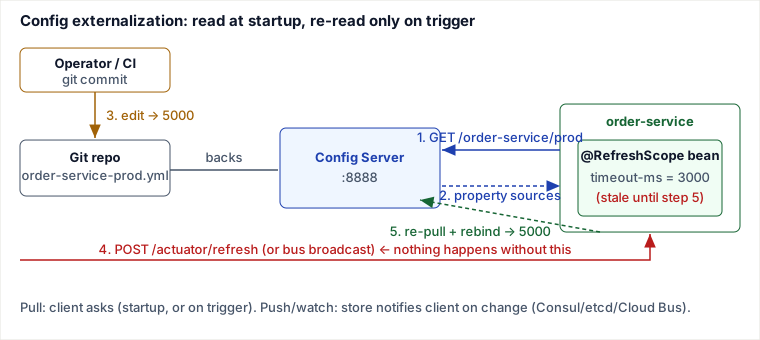
Worked trace: a database timeout change, with real values
Stack: Spring Cloud Config Server on :8888, Git-backed, serving order-service-prod.yml. The order-service has a bean holding payment.timeout-ms, annotated @RefreshScope. Twelve instances are running. Watch exactly where the value changes and where it does not.
| Step | Action | What the running instance sees |
|---|---|---|
| 1 | Instance boots, calls GET :8888/order-service/prod | Server returns property source; bean binds timeout-ms = 3000 |
| 2 | Traffic flows for hours | 3000 — held in memory, no further reads |
| 3 | Operator edits Git: 3000 → 5000, commits, pushes | Still 3000. Git changed; the process did not. |
| 4 | Nothing else done (the naive expectation) | Still 3000 on all 12 instances — indefinitely |
| 5 | POST :<instance>/actuator/refresh | Re-fetches; response body ["payment.timeout-ms"]; that bean is re-created; next request uses 5000 |
| 6 | Repeat step 5 for the other 11 — or POST /actuator/busrefresh once | Cloud Bus broadcasts over RabbitMQ/Kafka; all 12 rebind to 5000 |
The lesson from step 4: externalization alone gives you centralized editing, not automatic propagation. Propagation is a separate, explicit act. In-flight requests already using the old value are unaffected; only requests served after the rebind see 5000.
Pull vs. push: how propagation actually reaches the process
There are two families, and the difference is who initiates the transfer.
- Pull (client-initiated). The service asks. Spring Cloud Config is pull: fetch at startup, then re-fetch only when an actuator refresh (or a restart) is triggered. Kubernetes ConfigMaps mounted as a volume are also effectively pull — the kubelet syncs the file (roughly once per sync period, on the order of a minute) but your app must re-read the file to notice. ConfigMap values injected as environment variables never update in a running pod at all; they require a pod restart.
- Push / watch (store-initiated). The client subscribes and the store notifies it on change. Consul and etcd expose long-poll/watch APIs; Spring Cloud Bus simulates push by broadcasting a single refresh event to all instances over a message broker. This gives near-real-time propagation — but only because you added a watch or a broadcast channel. It is not free, and it is not the default.
So "real-time adaptation" is achievable, but it is a design choice (watch or bus), not an inherent property of externalizing config.
Pitfalls
- Assuming a Git commit is live. The most common mistake: change the source, expect behavior to change. Without a refresh trigger, restart, or watch, the process runs on stale in-memory values forever (trace step 4).
- Refreshing only one instance. Hitting
/actuator/refreshon one of 12 pods leaves the fleet in a split-brain config state — some on3000, some on5000. Use a fleet-wide mechanism (Cloud Bus, a rolling restart, or an orchestrator rollout). - @RefreshScope doesn't cover everything. Connection pools, thread pools,
@ConfigurationPropertiesnot wired for refresh, and values captured into local variables at startup won't pick up new values on refresh. Some changes genuinely need a restart — know which. - Config server as a hard startup dependency / SPOF. If instances can't boot without the config server and it's down, nothing starts. Cache the last-good config locally and make the server highly available.
- Secrets in plaintext Git. Committing API keys and DB passwords to the config repo leaks them into history forever. Use encryption (Spring's
{cipher}, Vault, SOPS, or a dedicated secrets store) and separate secrets from ordinary config. - No audit / rollback discipline. A bad value pushed to prod config is a production incident with no code deploy. Version the store (Git gives this), require review, and be able to revert the commit fast.
When to use it — and when not to
Reach for a config server when: you run many services/instances, you need to change behavior (feature flags, timeouts, rate limits) without redeploying, you need consistent config across environments from one source of truth, and you want an audit trail and rollback on config changes. The dynamic-refresh story is worth the machinery here.
Prefer simpler alternatives when:
- Environment variables /
.envfiles. Cheapest possible externalization; zero infra; works everywhere (12-factor style). You gain simplicity and no runtime dependency. You lose dynamic refresh (a change means a restart/redeploy), central visibility, and any audit trail. Choose env vars when you have a handful of services and config changes ride along with deploys anyway; prefer a config server when you need to change values on a live fleet or must see/version all config in one place. - Kubernetes ConfigMaps / Secrets. Native if you're already on K8s, integrates with RBAC and rollouts. You gain zero extra components. You lose true live refresh for env-injected values (needs pod restart), and volume-mounted updates are eventual and still require the app to re-read. Choose ConfigMaps when your platform is Kubernetes and restart-on-change is acceptable; prefer a dedicated config server when you need instant, watch-driven propagation or a platform-agnostic store.
- Consul / etcd (KV + watch). Buys you genuine push-based, near-real-time propagation. Costs you an additional distributed system to run and reason about (quorum, watches, connection churn). Choose this when sub-second propagation across the fleet is a real requirement; prefer pull+bus when "within a few seconds after an explicit trigger" is good enough.
The senior trade-off: every step toward real-time propagation (pull → pull+bus → watch) adds a moving part and a new failure mode. Buy only as much immediacy as the use case demands.
Takeaways
- Externalizing config gives you centralized, versioned editing — not automatic runtime adaptation. Values are read at startup and cached in memory.
- A live change takes effect only via a restart, an explicit refresh trigger, or a client-side watch. Editing the store alone changes nothing in a running process.
- Choose the propagation model deliberately: pull (simple, on-trigger) vs. push/watch (real-time, more infra) — and refresh the whole fleet, not one instance.
- Treat the config store as production-critical: encrypt secrets, make the server HA, and keep audit + rollback.
Re-authored/Deepened for this guide. Sources: Spring Cloud Config and Spring Boot Actuator reference documentation (@RefreshScope, /actuator/refresh, Spring Cloud Bus busrefresh); Chris Richardson, Microservices Patterns (Externalized Configuration pattern); Kubernetes documentation on ConfigMaps and Secrets (mounted-volume vs. env-var update semantics); HashiCorp Consul and etcd KV/watch documentation; Adam Wiggins, The Twelve-Factor App (Config).
🤖 Don't fully get this? Learn it with Claude
Stuck on Unveiling the Architecture How Does Configuration Externalization Work? Open Claude, copy a block below, and it'll teach you this exact concept — visually and interactively.
Build the mental picture, not memorization.
I just read a lesson on **Unveiling the Architecture How Does Configuration Externalization Work** (System Design) and want to truly understand it. Explain Unveiling the Architecture How Does Configuration Externalization Work from first principles using ONE vivid real-world analogy and a visual mental model — draw it as ASCII art or a clear step-by-step diagram — with a concrete example using real numbers. Then ask me one question to check I got the mental picture, and wait for my reply. If you're unsure or a claim isn't standard, say so and reason from first principles instead of guessing.
Socratic — adapts to where you're stuck.
Teach me **Unveiling the Architecture How Does Configuration Externalization Work** interactively. Ask me ONE guiding question at a time, wait for my answer, and adapt to my confusion — build the idea with me step by step instead of explaining it all at once. If you're unsure or a claim isn't standard, say so and reason from first principles instead of guessing.
Active recall exposes what you missed.
Quiz me on **Unveiling the Architecture How Does Configuration Externalization Work** with 5 questions, easy to tricky, ONE at a time. Tell me if each answer is right; at the end, explain clearly what I got wrong and why. If you're unsure or a claim isn't standard, say so and reason from first principles instead of guessing.
Intuition + hook + flashcards for long-term memory.
Help me remember **Unveiling the Architecture How Does Configuration Externalization Work** for the long term: give the one-sentence intuition, a memorable hook/mnemonic, a tiny worked example, and 3 active-recall flashcards (Q -> A). If you're unsure or a claim isn't standard, say so and reason from first principles instead of guessing.