Microservices Resilience — Circuit Breaker, Bulkhead & CQRS: the Missing Canonical Patterns (Deep Dive)
Three patterns, one underlying move: stop sharing the failure
Circuit Breaker, Bulkhead, and CQRS look unrelated — one is about calling a dependency, one is about thread pools, one is about database models — but they all fix the same defect: an unbounded shared resource lets one bad participant consume the whole thing and drag healthy work down with it. The fix is always the same move: isolate the resource, and fail fast instead of waiting. This page introduces all three at the intuition layer and then traces one concrete outage that shows exactly what happens when that isolation is missing.
Circuit breaker: fail fast instead of hammering a dying dependency
A circuit breaker wraps a call to a dependency and watches its recent outcomes. Once failures or latency cross a threshold over a rolling window, it trips — from that moment it rejects calls immediately instead of letting them hang, exactly like the breaker in a fuse box cutting power to a faulty circuit instead of letting it keep drawing current.
- CLOSED (normal) — calls pass through; the breaker counts failures/latency in a rolling window.
- OPEN (tripped) — the threshold was crossed. Calls are rejected instantly for a cool-down period; the caller gets a fast fallback instead of a hung request, and the failing dependency gets room to recover instead of more load.
- HALF-OPEN (probing) — after the cool-down, a few trial calls are let through. They succeed → back to CLOSED. They fail → back to OPEN.
Why microservices specifically need this: a synchronous call chain (checkout → payment → card-vault) has no natural circuit breaker of its own — without one, a slow dependency doesn't just slow down its direct caller, it cascades through every hop above it, as the traced outage below shows. The full state machine — exact trip windows, retry-vs-breaker layering, and a step-through debugger — already has its own deep dive elsewhere in this guide (the distributed circuit-breaker deep dive); the open question that page focuses on and this one doesn't is what happens with N instances of the calling service, each running its own breaker — per-instance tripping (fast, no coordination, but flappy and inconsistent across instances) versus a coordinated/shared breaker state (consistent, but adds a coordination dependency of its own).
Bulkhead: the ship-compartment analogy
A cargo ship survives a hull breach because its hull is divided into watertight compartments — flooding stays local to one compartment instead of sinking the ship. A software bulkhead applies the same idea to a shared resource: instead of one thread pool (or connection pool) serving every downstream dependency, give each dependency — or each class of caller — its own dedicated pool. If one dependency goes slow, it can only exhaust its own pool; every other pool, and everything that uses them, keeps working.
The question a bulkhead alone doesn't answer is how big should each pool be: too small and you throttle a perfectly healthy dependency under normal load; too large and it stops being an isolation boundary at all. That's a queueing-theory problem — Little's Law relates arrival rate, pool size, and wait time — and it's worked out in full in the bulkhead-sizing deep dive elsewhere in this guide. This page fixes the concept only: isolate first, size later.
CQRS: split the model that's easy to write from the model that's easy to read
A normal CRUD service serves both writes and reads from one model — usually one normalized schema. Normalization is exactly what a write wants (no duplicate data to keep consistent, invariants enforced in one place) and often exactly what a read doesn't want (a read frequently needs data joined, aggregated, or shaped very differently from how it was written). CQRS (Command Query Responsibility Segregation) resolves that tension by splitting the model in two:
- Write model (commands) — normalized, enforces invariants, optimized for correctness and consistency on writes.
- Read model (queries) — denormalized, shaped for the exact query patterns callers need, and scaled/cached/indexed independently of the write side. It's kept up to date asynchronously from the write model (often via events).
It earns its complexity when read and write are asymmetric enough that one schema genuinely can't serve both well — heavy read volume needing a different shape than the write side, or each side needing to scale or evolve on its own timeline. It's overkill for plain CRUD with a balanced read/write ratio and no shape mismatch: two schemas, a sync pipeline, and eventual consistency are a real, ongoing cost that a single well-indexed model plus read replicas would avoid. The mechanics of keeping the read model in sync — event sourcing, projections, and the consistency-lag trade-offs — are covered at full depth in the CQRS / event-sourcing deep dive elsewhere in this guide.
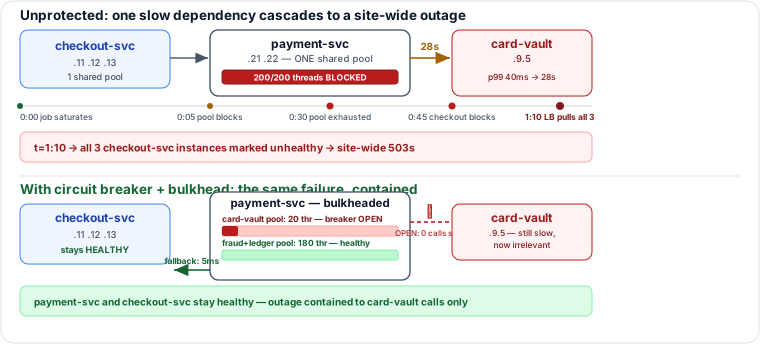
The failure trace: one slow dependency, unprotected
Three instances of checkout-svc (10.0.4.11–.13) call two instances of payment-svc (10.0.6.21–.22), which calls a single card-vault instance (10.0.9.5) for card tokenization. Neither service has a circuit breaker or a bulkhead: payment-svc routes card-vault, fraud-check, and ledger-write calls through one shared 200-thread HTTP client pool, and checkout-svc does the same for its calls to payment-svc.
| Time | Event |
|---|---|
| 14:02:00 | A nightly reconciliation job on card-vault (10.0.9.5) saturates its DB connection pool. p99 latency for card-vault calls jumps from ~40ms to ~28s. |
| 14:02:05 | payment-svc's calls to card-vault start blocking for up to the 30s connect timeout — and they hold a thread from the shared pool while they wait. |
| 14:02:30 | All 200 threads in payment-svc's shared pool are blocked on card-vault. Calls to the perfectly healthy fraud-check and ledger-write dependencies can no longer get a thread — they queue behind stuck card-vault calls. |
| 14:02:33 | payment-svc's own /health endpoint shares the same pool. It stops responding inside its 5s check window. |
| 14:02:45 | checkout-svc calls payment-svc through its own single shared pool. Those calls now block too — the same pattern, one hop up. |
| 14:03:10 | checkout-svc's health checks — queued behind the same stuck calls — start failing. The load balancer marks all three checkout-svc instances unhealthy and pulls them from rotation. |
| 14:03:15 | Every request hitting the edge now gets a 503. The site is down — because of one slow dependency two hops from the edge. |
| ~14:12 | On-call kills the reconciliation job. Recovery is slow: thread pools drain gradually, and a retry storm from every queued client makes card-vault's recovery bumpy. |
How circuit breaker + bulkhead would have contained it
Give payment-svc a bulkhead: a dedicated 20-thread pool for card-vault calls, separate from a 180-thread pool shared by fraud-check and ledger-write. Wrap the card-vault calls in a circuit breaker tripping at, say, >50% of the last 20 calls exceeding 2s.
- 14:02:05–14:02:15 — card-vault calls start timing out; within the 20-call window the error/latency rate crosses 50% and the breaker trips OPEN.
- From 14:02:15 on — calls to card-vault fail instantly with a fallback ("payment pending — retry shortly") instead of blocking a thread for 28s. The card-vault pool sits idle/rejecting, but the other 180 threads keep serving fraud-check and ledger-write exactly as before.
- payment-svc's
/healthnever shares a thread with the stuck dependency, so it stays green. checkout-svc's calls to payment-svc keep succeeding. - The load balancer never pulls a single checkout-svc instance. The outage is contained to "payments show a temporary retry banner" instead of a site-wide 503 — the same underlying dependency failure, two orders of magnitude smaller blast radius.
Pitfalls
- Circuit breaker with no fallback — tripping to OPEN just swaps a hung request for a fast exception if the caller has nothing sensible to do with a rejected call. Always pair OPEN with a real fallback: cache, default value, or a queued retry.
- Trip threshold on raw count, not rate — "trip after 20 failures" fires falsely during a traffic spike and never fires during low traffic with a 100% failure rate. Use an error-rate over a rolling window instead.
- Bulkhead sized by guesswork — a pool that's too small throttles a perfectly healthy dependency under normal load; too large and it stops isolating anything. Sizing is a queueing-theory derivation (Little's Law), not a round number — see the bulkhead-sizing deep dive.
- Bulkhead on the server side only — isolating threads inside payment-svc doesn't help if checkout-svc's own outbound client still uses one shared pool for every downstream call. Isolation has to exist on both sides of a call that matters, as the trace above shows.
- CQRS replication lag surfacing as a "bug" — a client writes, immediately reads its own write from the denormalized, asynchronously-updated read model, and sees stale data. That's inherent to CQRS with eventual consistency, not a defect to chase — design the UI around it (optimistic update, read-your-writes routing, or a synchronous path for the one query that needs it).
- CQRS applied to plain CRUD — two schemas, a sync pipeline, and eventual consistency are a real, ongoing tax. Paying it without a genuine read/write asymmetry to justify it is pure complexity with no return.
Judgment: when each pattern earns its complexity
| Pattern | Use it when | Skip it when | vs. a named alternative |
|---|---|---|---|
| Circuit Breaker | Any synchronous call to a dependency that can degrade or go down — especially cross-service, cross-network calls | In-process calls with no I/O — there's nothing to trip on | vs. timeout + retry alone: retry survives a transient blip but keeps hammering a truly dead dependency; only a breaker stops sending load and fails fast |
| Bulkhead | A service calls multiple downstream dependencies of different reliability/criticality — isolate the risky one(s) | A service with a single downstream dependency — there's nothing to isolate it from | vs. rate limiting: a limiter caps total demand into a resource; a bulkhead partitions an existing resource so one consumer can't take all of it — complementary, not a substitute |
| CQRS | Read/write load or shape is heavily asymmetric and each side needs to scale or evolve independently | Balanced CRUD with no scaling asymmetry — the dual schema and sync pipeline cost more than they save | vs. a single model + read replicas: replicas solve most read-scaling needs with no schema divergence and less consistency lag; reach for full CQRS only when the read shape, not just the read volume, differs from the write shape |
Takeaways
- All three patterns are the same idea wearing different clothes: stop letting one bad participant monopolize a shared resource — a thread pool (bulkhead), a call to a dead dependency (circuit breaker), or query load (CQRS's read model).
- The outage above happened because one resource — a shared thread pool with no isolation and no fail-fast — turned a local slowdown into a global one. That combination is the actual root cause, not "card-vault was slow."
- These are intro mechanics. The per-instance-vs-coordinated breaker state, Little's-Law pool sizing, and the CQRS/event-sourcing consistency trade-offs are covered at full depth in the distributed circuit-breaker, bulkhead-sizing, and CQRS/event-sourcing deep dives elsewhere in this guide.
- In an interview, naming the isolation boundary — what shares fate with what today, and how you'd cut it — matters more than naming the pattern.
Related pages
- Service Discovery & Distributed Circuit Breakers — Detection Lag, CAP Stance, Registry Herd & Per-Instance vs Coordinated State (Deep Dive) — System Design — the full circuit-breaker state machine across N instances
- Bulkhead & Sidecar in Depth — Fail-Fast Semantics, Little's-Law Sizing, Over-Partitioning & Sidecar-vs-Mesh (Deep Dive) — System Design — how to size the thread pool this page only says to isolate
- CQRS & Event Sourcing in Depth — Optimistic Concurrency, Projection Ordering & Multi-Projection Offsets (Deep Dive) — System Design — the consistency-lag mechanics behind CQRS's read model
- Designing for Failure — Blast Radius, Timeouts, Breakers & Bulkheads — System Design — the same isolate-and-fail-fast philosophy at the design-mindset level
- What Are the Differences Between a Circuit Breaker, Retry With Backoff, and Rate Limiting — System Design — how these resilience patterns compare to each other
Re-authored/Deepened for this guide.
🤖 Don't fully get this? Learn it with Claude
Stuck on Microservices Resilience — Circuit Breaker, Bulkhead & CQRS: the Missing Canonical Patterns (Deep Dive)? Open Claude, copy a block below, and it'll teach you this exact concept — visually and interactively.
Build the mental picture, not memorization.
I just read a lesson on **Microservices Resilience — Circuit Breaker, Bulkhead & CQRS: the Missing Canonical Patterns (Deep Dive)** (System Design) and want to truly understand it. Explain Microservices Resilience — Circuit Breaker, Bulkhead & CQRS: the Missing Canonical Patterns (Deep Dive) from first principles using ONE vivid real-world analogy and a visual mental model — draw it as ASCII art or a clear step-by-step diagram — with a concrete example using real numbers. Then ask me one question to check I got the mental picture, and wait for my reply. If you're unsure or a claim isn't standard, say so and reason from first principles instead of guessing.
Socratic — adapts to where you're stuck.
Teach me **Microservices Resilience — Circuit Breaker, Bulkhead & CQRS: the Missing Canonical Patterns (Deep Dive)** interactively. Ask me ONE guiding question at a time, wait for my answer, and adapt to my confusion — build the idea with me step by step instead of explaining it all at once. If you're unsure or a claim isn't standard, say so and reason from first principles instead of guessing.
Active recall exposes what you missed.
Quiz me on **Microservices Resilience — Circuit Breaker, Bulkhead & CQRS: the Missing Canonical Patterns (Deep Dive)** with 5 questions, easy to tricky, ONE at a time. Tell me if each answer is right; at the end, explain clearly what I got wrong and why. If you're unsure or a claim isn't standard, say so and reason from first principles instead of guessing.
Intuition + hook + flashcards for long-term memory.
Help me remember **Microservices Resilience — Circuit Breaker, Bulkhead & CQRS: the Missing Canonical Patterns (Deep Dive)** for the long term: give the one-sentence intuition, a memorable hook/mnemonic, a tiny worked example, and 3 active-recall flashcards (Q -> A). If you're unsure or a claim isn't standard, say so and reason from first principles instead of guessing.