Bulkhead & Sidecar in Depth — Fail-Fast Semantics, Little's-Law Sizing, Over-Partitioning & Sidecar-vs-Mesh (Deep Dive)
The introductory treatment of these two patterns elsewhere in this guide covers what each one is: the ship-compartment analogy behind the Bulkhead, and the Pod/iptables mechanics behind the Sidecar. This page does not repeat that — it goes one level deeper into the numbers and the judgment calls a senior engineer actually has to make: exactly what a bulkhead does the instant it saturates, how to size one with Little's Law instead of a guess, what repeated retries do to it, when isolation itself becomes the more expensive choice, and the sidecar's real per-Pod bill, its startup-ordering failure modes, and the alternatives to reach for instead.
Fail-fast is the point, not a side effect
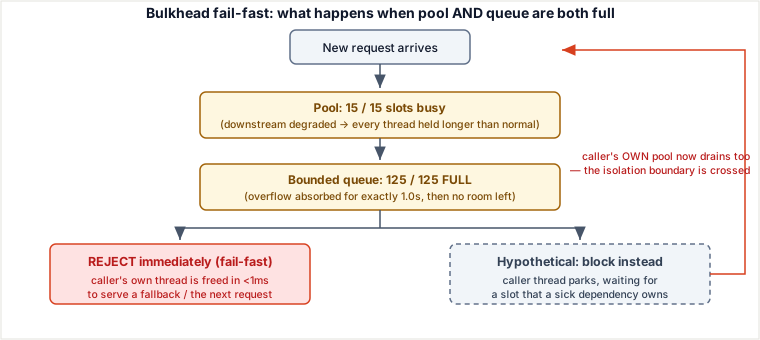
A bulkhead is two bounded resources stacked together: a fixed-size pool (threads or permits) and a bounded queue in front of it. Both are finite by design. The interesting moment is what happens when both are simultaneously full and one more request arrives — there are exactly two choices, and only one of them preserves the pattern's purpose.
Block the caller until a slot frees up looks gentler, but it silently converts the caller's own thread into a hostage of the failing dependency. If that caller thread came from another pool — say, the web server's own request-handling pool — then blocking on a full bulkhead means that pool now drains in sympathy with the dependency's pool. The isolation boundary the bulkhead exists to enforce has just been crossed backward, and the caller service is exhausted by proxy.
Reject immediately (fail-fast) is the correct behaviour: return control to the caller in well under a millisecond — a thrown RejectedExecutionException in a plain Java ThreadPoolExecutor, or a BulkheadFullException in Resilience4j — so the caller's own thread stays free to do something useful: serve a fallback, read from cache, or simply fail the one request instead of threatening every request behind it. The rejection is not the bulkhead failing; it is the bulkhead doing its job. Anything that turns a full bulkhead into a wait is quietly deleting the isolation guarantee it was built to provide.
Sizing a bulkhead with Little's Law, not a guess
Little's Law relates the average number of requests concurrently occupying a system (L) to the arrival rate (λ) and the average time each one occupies the system (W): L = λ · W. For a bulkhead, L is exactly the pool occupancy you need in order to keep up with steady-state traffic without queuing.
Worked example. The Inventory dependency is called at λ = 200 requests/second, and it responds in W = 50ms = 0.05s on average.
L = λ · W = 200 × 0.05 = 10At steady state, 10 concurrently-busy slots are enough to absorb 200 req/s at 50ms each. But average latency is not the whole story — real traffic is bursty and the mean hides the tail — so size the pool to L plus headroom rather than to L exactly. A common rule of thumb is 30–50% headroom: 10 × 1.5 = 15, so the pool gets 15 slots. At the normal 50ms latency that pool can sustain 15 / 0.05 = 300 req/s before it needs to queue at all — comfortable headroom over the 200 req/s it actually sees (~67% utilization).
The bounded queue is sized separately, and for a different reason: it should absorb a short burst, not paper over a sustained problem. Trace what happens when Inventory degrades: at t = 0, its latency jumps from 50ms to W′ = 200ms (4× slower) while arrivals stay at 200 req/s. The pool's throughput capacity collapses to 15 / 0.2 = 75 req/s, so the overflow that has to go somewhere is 200 − 75 = 125 req/s. With a queue capacity of 125:
| Time | Pool | Queue | State |
|---|---|---|---|
| t = 0.0s | 15 / 15 busy | 0 / 125 | Latency jumps to 200ms; overflow starts at 125 req/s |
| t = 0.5s | 15 / 15 busy | ≈63 / 125 | 125 req/s × 0.5s ≈ 63 queued |
| t = 1.0s | 15 / 15 busy | 125 / 125 (FULL) | 125 req/s × 1.0s = 125 → queue exactly full |
| t > 1.0s | 15 / 15 busy | 125 / 125 (FULL) | Further requests are rejected immediately, not queued or blocked |
The queue bought exactly one second of burst absorption before the bulkhead had to start protecting the rest of the system with rejections — and that number came from a deliberate choice (125 slots), not from leaving the queue unbounded. An unbounded queue is not a safer choice: it does not prevent the failure, it only delays it and moves it somewhere worse — unbounded memory growth and a caller-visible latency that silently climbs past any useful timeout, instead of a clean, fast rejection at a known threshold.
Retry amplification: r^N, and the budget that caps it
A bulkhead contains a dependency's failure inside its own compartment, but it does not stop the rest of the system from retrying into that compartment — and retries compound multiplicatively across a call chain. Consider a 3-tier chain — an edge/API layer calling Service A calling Service B — where every tier is configured to retry up to r = 3 times on failure. That chain has 2 retry-amplifying hops (edge→A, then A→B). If each tier's retry independently re-triggers the full retry policy of the tier below it, the number of requests that can land on the bottom-most service for a single top-level logical request approaches:
r^hops = 3^2 = 9One user request can turn into up to 9 calls at the deepest dependency the moment that dependency starts erroring — from that dependency's point of view, a self-inflicted 9× traffic spike it never provisioned for, arriving at exactly the moment it is least able to absorb it. This is how a single flaky downstream turns into a full outage: the retries meant to paper over a transient blip become the load that keeps the dependency down.
The fix is a retry-budget token bucket: cap total retries to a fixed fraction of the accepted (non-retry) request volume, commonly around 10%. Concretely — if the service accepts 200 non-retry req/s, the retry-budget bucket refills at 200 × 0.10 = 20 tokens/second (with a small burst allowance, e.g. 20 tokens capacity). Every retry attempt, at any tier, must spend one token from this shared budget; once it is empty, further retries simply do not happen — the caller gets the failure instead. This flattens the r^N ceiling into a hard, load-proportional cap that cannot storm no matter how many tiers are individually configured to retry 3 times each.
None of this is safe to enable, though, unless two preconditions hold: the operation being retried is idempotent (retrying it twice has the same effect as once), and the failure has been classified as retryable — timeouts, connection resets, 503/429 — never a 400, and never a write whose side effect may already have landed on the far side of a timeout.
When isolation costs more than it saves
Every bulkhead reserves capacity that sits idle whenever its dependency is healthy — and that reserved capacity is not available to any other dependency, even one that is starving for it right now. This is the isolation-vs-utilization trade-off, and it is easiest to see with numbers.
Worked comparison. A service calls 10 downstream dependencies, and its container gives it a hard ceiling of 200 concurrent worker slots — that is what the CPU/memory allocation physically supports. Partitioned: give each of the 10 dependencies a fixed, reserved pool of 20 slots (10 × 20 = 200, the entire budget spent up front). Traffic is uneven, as it always is in practice — at any moment only 3 of the 10 dependencies are actually hot, together needing roughly 150 concurrent slots to keep up with their combined load. But partitioned, each of those 3 is capped at its own 20, so at most 3 × 20 = 60 of the 150 needed slots are ever available — the other 90 units of demand queue or get rejected, even though the other 7 dependencies are idle and sitting on 140 completely unused reserved slots. A single shared work-stealing pool of the same 200 slots would let those 3 hot dependencies draw up to 150 (or the full 200) from the common budget, serving the identical burst with zero rejections.
Aggregate throughput is lower under over-partitioning because of the isolation, not despite it: the reservation that protects each dependency from its neighbours also walls it off from their spare capacity. When not to bulkhead: a single dependency (there is no neighbour to protect against), a small number of low-variance dependencies where reserved capacity already tracks real need closely, or a resource budget too tight to afford full partitioning's safety margin. In those cases prefer a shared pool guarded more lightly — a per-dependency semaphore-based concurrency limiter plus a circuit breaker — over full thread-per-dependency partitioning.
Sidecar depth: the per-Pod bill and the extra hop
The sidecar's convenience — language-agnostic, uniformly-enforced cross-cutting behaviour — is not free, and the cost scales with fleet size in a way that is easy to underestimate from a single Pod.
Per-Pod resource cost. A commonly cited floor for an Envoy sidecar's resource requests is on the order of 0.1 vCPU and 128Mi memory per proxy (limits are usually set higher to absorb spikes, but the requested floor is what the scheduler reserves whether traffic is flowing or not). At 1,000 Pods, that floor alone reserves 1000 × 0.1 = 100 vCPU and 1000 × 128Mi = 125GiB of memory — before a single line of application code runs. At 5,000 Pods, the same arithmetic gives 500 vCPU and 625GiB. This is a cluster-wide bin-packing tax that scales linearly with Pod count, which is exactly the number that worries a systems designer at fleet scale, not a per-request cost.
Per-hop latency. Every request now crosses two extra localhost proxy hops — the caller's outbound Envoy listener and the callee's inbound Envoy listener — even though both sit on loopback. Each hop still spends real time on TLS work, route matching, and telemetry recording, commonly cited at low single-digit milliseconds at p50 (more at higher percentiles under load). Tolerable for one hop, but it compounds: a request that fans out across a five-service call chain crosses ten sidecar hops (two per service), which can add tens of milliseconds of pure proxy tax before any dependency has done real work.
Lifecycle failure modes. Because the sidecar and the app are separate containers sharing a Pod, their startup and shutdown are not automatically synchronized unless something enforces it. Two concrete failure modes recur in production: (1) the sidecar starts after, or isn't ready before, the app — the app's first outbound calls hit iptables rules that already redirect to the proxy's listener port, but nothing is listening there yet, so the connection is refused even though "the network is up"; (2) the sidecar dies before the app during shutdown — if the proxy container is torn down first, in-flight and new outbound calls from the still-running, still-healthy app fail purely because its egress path just disappeared.
Fixes. Kubernetes native sidecars (a container declared in initContainers with restartPolicy: Always, covered in the architecture treatment elsewhere in this guide) guarantee the proxy starts before the app containers and stops after them. Where that isn't available or isn't enough, Istio's holdApplicationUntilProxyStarts: true annotation blocks the app container from starting until the proxy's readiness probe passes, and a configured terminationDrainDuration keeps the proxy alive through the shutdown grace period so it keeps serving the app instead of vanishing first.
Choosing the shape: sidecar vs in-process library vs node DaemonSet vs ambient mesh
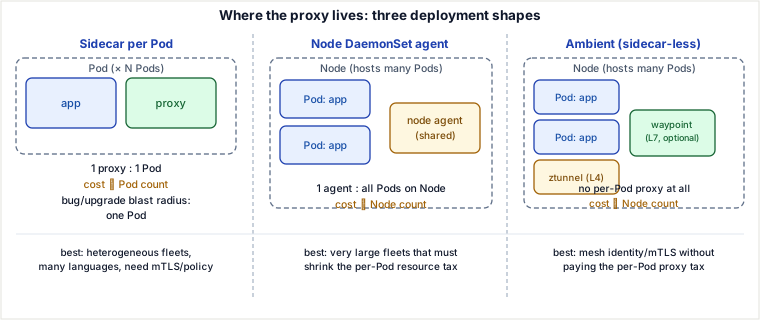
The sidecar is one point on a spectrum of where cross-cutting logic can live. The selection is a real trade-off, not a default.
| Shape | Per-workload overhead | Blast radius | Language-agnostic? | Best fit |
|---|---|---|---|---|
| Sidecar per Pod | One proxy per Pod — cost scales with Pod count | Contained to one Pod | Yes | Heterogeneous, many-language fleets needing uniform mTLS/policy |
| In-process library | Zero extra process; cost is inside the app's own resource envelope | Contained to one app instance/version, but every service must be redeployed to update | No — one library per language/runtime | Small, homogeneous fleet; latency-critical hot path |
| Node DaemonSet agent | One agent per Node — cost scales with Node count, shared across all Pods on it | A Node-level bug/outage affects every Pod scheduled there | Yes | Very large fleets that must shrink the per-Pod resource tax |
| Ambient / sidecar-less mesh | Per-Node ztunnel (L4) plus optional shared waypoint (L7) — cost scales with Node count | ztunnel bug affects every Pod on the Node (L4); waypoint bugs affect only workloads routed through it | Yes | Fleets wanting mesh identity/mTLS while removing the per-Pod proxy tax, willing to adopt a newer, less battle-tested model |
Net trade-off. A sidecar buys language-agnostic, independently-upgradable, uniformly-enforced networking and security, and the bill comes due as per-Pod resource overhead, added per-hop latency, and startup-ordering complexity. A DaemonSet or ambient mesh trades some of that isolation (a shared blast radius per Node) for a resource bill that scales with Node count instead of Pod count — usually a large win once Pods-per-Node is high. An in-process library removes the extra hop and the extra container entirely, at the cost of reimplementing and redeploying the logic per language.
Pitfalls
- Unbounded queues. A bulkhead with a bounded pool but an unbounded queue has not actually failed fast — it has just relocated the failure into unbounded memory growth and a caller-visible latency that silently climbs past any useful timeout.
- Sizing from the mean only. Little's Law sizing off average
Wignores the tail: a burst of p99-latency requests can saturate a pool sized only for the typical case, which is exactly why headroom above the rawLmatters. - Retrying without idempotency or error classification. A retry budget caps the volume of retries, but it does not make an unsafe retry safe — retrying a non-idempotent write on a false-negative timeout can double-charge or double-ship before the budget even becomes relevant.
- Treating sidecar cost as free at low traffic. The resource request is reserved by the scheduler whether or not the proxy is busy — an idle-looking sidecar still bills its floor against cluster capacity.
- Deploying sidecars as ordinary containers. Without
restartPolicy: AlwaysininitContainers(or an equivalent startup gate), rolling deploys and scale-downs routinely hit the start-after / die-before races described above.
Takeaways
- Fail-fast is correctness, not harshness. Blocking on a full bulkhead just relocates the exhaustion into the caller's own pool; rejecting in <1ms is what actually preserves isolation.
- Size with Little's Law, then add headroom, then bound the queue on purpose.
L = λ · Wgives the floor; an unbounded queue is never the safer choice — it just defers the same failure to a worse place. r^Nretry amplification is real, and only a load-proportional retry budget (a token bucket, commonly ≈10%) stops it from becoming a self-inflicted storm — and only for idempotent, correctly-classified-retryable errors.- Isolation has a utilization cost, and so does a sidecar's per-Pod tax. Over-partitioning can lower aggregate throughput below a shared pool's; choose bulkhead granularity, and sidecar vs library vs DaemonSet vs ambient mesh, to match the actual traffic and fleet shape — not by reflex.
Sources
Little's Law: J. D. C. Little, “A Proof for the Queuing Formula: L = λ W,” Operations Research, 1961. Bulkhead mechanics and fail-fast rationale cross-checked against Michael T. Nygard, Release It! Design and Deploy Production-Ready Software (2nd ed., Pragmatic Bookshelf, 2018) and the Resilience4j Bulkhead documentation (ThreadPoolBulkhead vs SemaphoreBulkhead). Retry-storm and retry-budget reasoning follows the AWS Builders' Library, “Timeouts, retries, and backoff with jitter” (Marc Brooker) and Google's Site Reliability Engineering handling-overload chapter. Sidecar cost, latency, and lifecycle detail draws on Istio documentation (native sidecars, holdApplicationUntilProxyStarts, ambient mesh ztunnel/waypoint architecture) and Kubernetes documentation on native sidecar containers (SidecarContainers feature gate). The sizing arithmetic, the r^N and retry-budget figures, the over-partitioning comparison, and the per-Pod cost/latency estimates are worked derivations for this guide, not quotations from any single source.
Related pages
- The Bulkhead Pattern A Solution — the base mechanics (thread pools, semaphores, isolation) this deep dive assumes and builds past
- Introduction to the Sidecar Pattern — the Pod/iptables fundamentals behind the per-Pod cost and lifecycle issues covered here
- The Circuit Breaker Pattern An Effective Shield Against Cascading Failures — the companion resilience pattern usually paired with bulkheads to stop cascading failure
- What Are the Differences Between a Circuit Breaker, Retry With Backoff, and Rate Limiting — situates the retry-budget reasoning on this page against the wider resilience-pattern comparison
- Designing for Failure — Blast Radius, Timeouts, Breakers & Bulkheads — the broader mental model of blast-radius containment that bulkhead sizing serves
🤖 Don't fully get this? Learn it with Claude
Stuck on Bulkhead & Sidecar in Depth — Fail-Fast Semantics, Little's-Law Sizing, Over-Partitioning & Sidecar-vs-Mesh (Deep Dive)? Open Claude, copy a block below, and it'll teach you this exact concept — visually and interactively.
Build the mental picture, not memorization.
I just read a lesson on **Bulkhead & Sidecar in Depth — Fail-Fast Semantics, Little's-Law Sizing, Over-Partitioning & Sidecar-vs-Mesh (Deep Dive)** (System Design) and want to truly understand it. Explain Bulkhead & Sidecar in Depth — Fail-Fast Semantics, Little's-Law Sizing, Over-Partitioning & Sidecar-vs-Mesh (Deep Dive) from first principles using ONE vivid real-world analogy and a visual mental model — draw it as ASCII art or a clear step-by-step diagram — with a concrete example using real numbers. Then ask me one question to check I got the mental picture, and wait for my reply. If you're unsure or a claim isn't standard, say so and reason from first principles instead of guessing.
Socratic — adapts to where you're stuck.
Teach me **Bulkhead & Sidecar in Depth — Fail-Fast Semantics, Little's-Law Sizing, Over-Partitioning & Sidecar-vs-Mesh (Deep Dive)** interactively. Ask me ONE guiding question at a time, wait for my answer, and adapt to my confusion — build the idea with me step by step instead of explaining it all at once. If you're unsure or a claim isn't standard, say so and reason from first principles instead of guessing.
Active recall exposes what you missed.
Quiz me on **Bulkhead & Sidecar in Depth — Fail-Fast Semantics, Little's-Law Sizing, Over-Partitioning & Sidecar-vs-Mesh (Deep Dive)** with 5 questions, easy to tricky, ONE at a time. Tell me if each answer is right; at the end, explain clearly what I got wrong and why. If you're unsure or a claim isn't standard, say so and reason from first principles instead of guessing.
Intuition + hook + flashcards for long-term memory.
Help me remember **Bulkhead & Sidecar in Depth — Fail-Fast Semantics, Little's-Law Sizing, Over-Partitioning & Sidecar-vs-Mesh (Deep Dive)** for the long term: give the one-sentence intuition, a memorable hook/mnemonic, a tiny worked example, and 3 active-recall flashcards (Q -> A). If you're unsure or a claim isn't standard, say so and reason from first principles instead of guessing.