The Solution Configuration Externalization Pattern
Configuration externalization works by making a service resolve its settings at runtime through a keyed lookup against a separate store — the client sends its identity (application, profile, label) to a config source, the source returns a layered, merged property set (most-specific layer wins), and a refresh channel lets already-running instances rebind to new values without a redeploy.
Concretely, that store is one of a handful of named systems, and the choice of system decides the two hard properties — how changes reach a live process, and how secrets and versions are handled:
- Spring Cloud Config Server — a git-backed HTTP server. The git history is your version log; a
labelselects a branch/tag/commit, so rollback isgit revert. Encrypted values are stored inline as{cipher}…. - HashiCorp Consul KV / etcd — key-value stores with watch / blocking queries: the client holds an open request and the server pushes the new value the instant a key changes (etcd exposes MVCC revisions for versioning).
- AWS SSM Parameter Store / Secrets Manager — parameters carry version numbers; Secrets Manager adds KMS encryption and scheduled rotation. Both are pull (poll or fetch-on-boot).
- Kubernetes ConfigMaps / Secrets — mounted as files or env vars; mounted files update in place (with a propagation delay), env vars do not update until the pod restarts.
Push vs. pull is the axis that trips people up. Spring Cloud Config is pull: a client only re-reads config when something triggers POST /actuator/refresh on it — which is why Spring Cloud Bus exists, broadcasting a single /actuator/busrefresh over Kafka/RabbitMQ so every instance refreshes at once. Consul/etcd are push: the watch delivers the change with no external trigger.
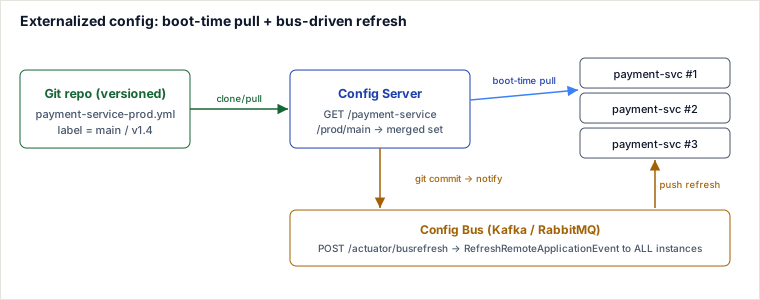
Worked example: what the merge actually returns
payment-service boots with spring.profiles.active=prod and label=main, so it calls GET http://config-server:8888/payment-service/prod/main. The server clones the git repo at main, reads four candidate files, and returns them as ordered propertySources — most-specific first. The effective value of each key is taken from the highest-priority source that defines it.
| Source (priority high→low) | Keys it defines |
|---|---|
| payment-service-prod.yml | payment.retry.max-attempts = 5; payment.gateway.url = https://gw.prod.internal |
| payment-service.yml | payment.timeout = 5000ms; payment.currency = USD |
| application-prod.yml | logging.level.root = WARN |
| application.yml | payment.retry.max-attempts = 3; payment.timeout = 2000ms; logging.level.root = INFO |
Resolving each key top-down gives the effective config the service runs with:
| Key | Effective value | Won over |
|---|---|---|
| payment.retry.max-attempts | 5 | application.yml's 3 (shadowed) |
| payment.timeout | 5000ms | application.yml's 2000ms |
| payment.currency | USD | — (only defined once) |
| logging.level.root | WARN | application.yml's INFO |
| payment.gateway.url | https://gw.prod.internal | — (only defined once) |
Now a live change, no redeploy. An operator raises the retry limit under load:
- Edit
payment-service-prod.yml:max-attempts: 5 → 8. Commit and push tomain. The git commit hash is now the version; rollback later isgit revert <hash>. - Fire once:
POST http://any-instance:8080/actuator/busrefresh. - Spring Cloud Bus publishes a
RefreshRemoteApplicationEventonto Kafka; everypayment-serviceinstance consumes it. - Each instance re-fetches from the config server, sees
max-attempts=8, and rebinds its@RefreshScopebeans. The next payment that fails now retries up to 8 times — on processes that were never restarted.
The code — and the bug the naive version hides
The client points itself at the server before the Spring context starts, so this lives in bootstrap.yml (or spring.config.import on newer versions):
spring:
  application:
    name: payment-service        # the {application} in the lookup
  profiles:
    active: prod                 # the {profile}
  cloud:
    config:
      uri: http://config-server:8888
      label: main                # the {label} = git ref
      fail-fast: true            # refuse to boot if server unreachable
      retry:
        max-attempts: 6          # ...but retry with backoff first
The bean that consumes a value that can change at runtime:
@Component
@RefreshScope   // <-- without this, retryLimit is frozen at startup
public class PaymentRetryPolicy {

    private final int retryLimit;

    public PaymentRetryPolicy(
            @Value("${payment.retry.max-attempts:3}") int retryLimit) {
        this.retryLimit = retryLimit;   // :3 = safe default if key absent
    }

    public int retryLimit() { return retryLimit; }
}
Why the naive version is wrong. Drop @RefreshScope and PaymentRetryPolicy is an ordinary eager singleton: its constructor runs exactly once at startup, capturing retryLimit = 5 into a final field. When the bus refresh updates the Spring Environment from 5 to 8, nothing re-creates the bean, so retryLimit() keeps returning 5 forever — the config server says 8, production behaves as 5, and you chase a ghost. @RefreshScope wraps the bean in a proxy that discards its target on a refresh event and lazily rebuilds it on the next call, so the constructor re-runs and re-reads 8. (Beans bound with @ConfigurationProperties get rebound automatically and don't need the annotation — @Value singletons do.)
The Go equivalent using Viper against a Consul watch (push model — no external trigger needed):
v := viper.New()
v.AddRemoteProvider("consul", "consul:8500", "config/payment-service/prod")
v.SetConfigType("yaml")
_ = v.ReadRemoteConfig()

for {
    time.Sleep(5 * time.Second)
    if err := v.WatchRemoteConfig(); err == nil {
        atomic.StoreInt32(&retryLimit, int32(v.GetInt("payment.retry.max-attempts")))
    }
}
// readers use atomic.LoadInt32(&retryLimit) — no torn reads on refresh
Pitfalls
- The config server is now a boot-time dependency for your whole fleet. If it's down when a service starts and there's no local cache, the service can't boot. This turns config into a single point of failure. Mitigate with
fail-fast + retry, a client-side snapshot of last-known-good config, and running the server as multiple replicas behind git (which is itself the durable store). - Silent staleness with pull models. A change committed to git does nothing to running Spring instances until someone fires
busrefresh. Teams commit a fix, see it in git, and assume it's live — it isn't. Automate the refresh in your deploy/config pipeline, or use a push store (Consul/etcd) where staleness isn't possible. - Kubernetes env-var ConfigMaps never hot-reload. Values injected as environment variables are fixed for the pod's life; only volume-mounted ConfigMaps update in place (and even then with a kubelet sync delay of up to ~1 minute, and the app must re-read the file).
- Secrets in plaintext git. Externalizing to a git-backed server tempts people to commit DB passwords. Use
{cipher}encrypted values (Spring), or route secrets to Vault / AWS Secrets Manager and keep only non-secret config in git. A leaked repo = leaked credentials. - Refresh is not atomic across a change set. If two keys must change together, a mid-refresh instance can read the new value of one and the old value of the other. Version the whole set behind a single label/commit and refresh from that pinned ref, not key-by-key.
- No rollback discipline. "Central and dynamic" also means one bad edit hits every instance in seconds. Treat config changes like code: PR review, audit trail (git history / Parameter Store versions), and a rehearsed rollback (
git revert+ refresh).
When to use it — and when not to
Reach for externalized config when you have many instances/services sharing settings, need to change behavior (flags, limits, endpoints, log levels) without a redeploy, must keep dev/test/prod in sync from one source of truth, or need an audit trail and rollback for config changes. The clinching signal: you find yourself doing a full deploy just to flip a value.
Trade-offs vs. named alternatives:
- vs. baked-in config (properties in the jar): baked config is dead simple and has zero runtime dependency — the artifact is fully self-contained and can't fail to fetch. You give that up for the ability to change values without rebuilding. Prefer baked config for a single-instance app or values that genuinely never change between deploys.
- vs. plain env vars / 12-factor: env vars need no server and are the k8s-native default, but they're flat (no layering), can't hot-reload a running process, and don't give you versioning or a merge model. Prefer env vars when config is small, static per deploy, and you're happy to restart to change it. Choose a config server when you need layered profiles, live refresh, and history.
- Spring Cloud Config (git-backed, pull) vs. Consul/etcd (KV, push): git-backed gives you free versioning, diffs, and PR review, but refresh is manual (needs the bus) and it adds a server to operate. Consul/etcd give instant push and are already present if you run service discovery, but versioning/audit is weaker and encrypted-secret ergonomics are worse. Prefer Spring Cloud Config when git-as-audit-log and human review matter most; prefer Consul/etcd when zero-lag propagation matters most.
- vs. AWS Parameter Store / Secrets Manager: fully managed, IAM-scoped, KMS-encrypted, rotation built in — the least ops burden if you're on AWS. The cost is cloud lock-in, per-request throttling limits at high fan-out, and it's pull-only. Prefer it for secrets and for AWS-native stacks that don't want to run a config server.
Choose externalized config when live change-without-redeploy, cross-service consistency, or config audit/rollback are real requirements; prefer plain env vars or baked config when the settings are small, static per deploy, and a restart to change them is acceptable — the config server's availability and operational cost aren't worth paying for values you rarely touch.
Takeaways
- Externalization = keyed lookup (application, profile, label) → layered merge (most-specific wins) → runtime rebind; the store you pick decides versioning, secrets handling, and push-vs-pull.
- Push (Consul/etcd watches) propagates instantly; pull (Spring Cloud Config) does nothing until a refresh is triggered — automate
busrefreshor you'll ship stale config. - A live-changeable value must sit in a
@RefreshScope(or@ConfigurationProperties) bean; a plain singleton captures it once and ignores every later change. - You've traded a self-contained artifact for a shared runtime dependency — cache last-known-good, run replicas, keep secrets encrypted, and treat config edits with the same review/rollback rigor as code.
Sources: Spring Cloud Config & Spring Cloud Bus reference documentation (git-backed server, @RefreshScope, {cipher} values, busrefresh); HashiCorp Consul KV and etcd watch/blocking-query docs; AWS Systems Manager Parameter Store and Secrets Manager documentation; Chris Richardson, Microservices Patterns (Externalized Configuration); Adam Wiggins, The Twelve-Factor App (Config); Kubernetes ConfigMap/Secret documentation. Re-authored/Deepened for this guide.
🤖 Don't fully get this? Learn it with Claude
Stuck on The Solution Configuration Externalization Pattern? Open Claude, copy a block below, and it'll teach you this exact concept — visually and interactively.
Progressively stronger hints — you still solve it.
I'm working on the problem **The Solution Configuration Externalization Pattern** (System Design). Give me a HINT LADDER: start with the tiniest nudge, then wait. Only reveal the next, stronger hint when I ask. Do NOT show the full solution unless I type 'show solution'. Keep me doing the thinking. If you're unsure or a claim isn't standard, say so and reason from first principles instead of guessing.
See the technique, not just code.
Explain the optimal approach to **The Solution Configuration Externalization Pattern** with a VISUAL walkthrough: trace it on a small concrete example using ASCII art / a step-by-step diagram, narrate what changes each step, then give time & space complexity with a one-line derivation. If you're unsure or a claim isn't standard, say so and reason from first principles instead of guessing.
Catch bugs, edge cases, sub-optimality.
I'll paste my solution to **The Solution Configuration Externalization Pattern**. Review it for correctness, missed edge cases, and time/space complexity, then coach me toward the optimal — don't just rewrite it. Ask me to paste my code now. If you're unsure or a claim isn't standard, say so and reason from first principles instead of guessing.
Lock in recognition with look-alikes.
Give me 2 problems that use the SAME underlying pattern as **The Solution Configuration Externalization Pattern**. For each, let me attempt first, then review my answer and name the trigger signal that reveals the pattern. If you're unsure or a claim isn't standard, say so and reason from first principles instead of guessing.