Config & Secrets Externalization — Dynamic Refresh, Push-vs-Pull, Key Rotation & Fan-out Back-pressure (Deep Dive)
Config & Secrets Externalization — Dynamic Refresh, Push-vs-Pull, Key Rotation & Fan-out Back-pressure (Deep Dive)
The other config-externalization pages in this guide cover the pattern's basic mechanics: what the config server is, the (application, profile, label) lookup, and the refresh trap. This page is the canonical home for the next layer of judgment a senior engineer is expected to have: when dynamic refresh is actively the wrong tool, the real mechanics and merge rules behind push vs pull distribution, the propagation-latency budget a config change always carries, key rotation with versioned envelope encryption for secrets, and the thundering-herd back-pressure problem when a whole fleet cold-pulls config at once.
1. Dynamic refresh — and when it's the wrong answer
Hot-reloading a value at runtime only works if any single instance, holding any single value, at any single moment, is a valid state. That's true for a timeout or a log level. It's false the instant two instances must agree to interoperate — a wire format, a schema, or a resource pool sized against a shared constraint. Refreshing those in place doesn't just risk staleness; it creates a window where the fleet is inconsistent by construction, and inconsistency there is the incident, not a side effect of one.
Traced incident: a serialization-format flip via hot refresh. orders-svc (20 producer instances) publishes to Kafka topic orders.events. A config value serialization.format is bound to a @RefreshScope bean and toggled from json to avro to save bandwidth. analytics-ingest (8 consumer instances) reads that topic and expects JSON only — it was never told about the change, because config refresh only touches the producers.
| t | Event | Fleet state |
|---|---|---|
| 14:02:00 | Operator commits serialization.format: avro, fires POST /actuator/busrefresh | 20/20 producers on json; 8/8 consumers expect json-only |
| 14:02:02 | First 3 producers (closest on the bus) rebind and start emitting Avro | 3 producers avro, 17 still json — one topic, two formats, interleaved |
| 14:02:05 | A consumer instance polls a batch, hits an Avro record where it expects JSON.parse | Deserialization exception → consumer thread dies → group rebalance |
| 14:02:07 | Rebalance reassigns those partitions to healthy consumers, which immediately hit the same Avro records | Crash-loop propagates to all 8 consumers within ~15s |
| 14:02:40 | Bus fan-out finally reaches producer #20 | All producers now avro — but the entire consumer fleet is already down |
| 14:10 | On-call reverts the config value, refires busrefresh | Producers revert to json; consumers recover; ~8 minutes of dropped analytics events |
The bug wasn't in either service's code — both worked exactly as configured. The bug was treating a cross-instance contract change as if it were a local scalar. The correct sequence is a coordinated, restart-based rollout: ship consumers that can read both formats first (a real code deploy, not a config toggle), confirm they're running fleet-wide, then flip the producer config, and only later retire the old-format read path. A rolling restart is deliberately slower than a bus refresh for exactly this reason — the orchestrator health-checks each replaced instance before moving to the next, giving you a gate a fire-and-forget refresh doesn't have.
The general rule: reach for dynamic refresh only for values where a temporary mismatch between instances is harmless drift (a timeout, a log level, a feature-flag rollout percentage). The moment a value defines how one instance's output is interpreted by another — a wire format, a partitioning scheme, a resource limit shared across a pool — a mixed-version fleet isn't stale, it's broken, and that calls for a coordinated restart or a multi-phase (dual-read/dual-write) rollout instead.
2. Push vs pull — the canonical distribution model
Every config-distribution system is one of two shapes, and the difference is who initiates the transfer:
- Pull (client-initiated polling). The client asks on an interval — "anything new since my last poll?" Simple: no channel to keep alive, no server-side subscriber list. Two costs come bundled in: staleness is bounded below by the poll interval (poll every 30s, and the worst case is ~30s stale, even though nothing "failed"), and a poll storm — if every one of N instances polls independently, the server sees N requests per interval regardless of whether anything changed, and a mass restart (§5) turns that into a spike.
- Push (server-initiated notification). The client opens a long-lived watch/stream and the server notifies it the instant something changes. Propagation is close to the speed of the network, not the poll interval — but you've now taken on a stateful channel: the server must track which clients are subscribed and to what, and the client must handle disconnect/reconnect (miss a notification during a network blip, and you need a resync — typically a version number or watch-index the client presents on reconnect to ask "what did I miss since X?").
The merge/precedence rules (layered config), stated once, canonically: real systems don't serve one flat value — they resolve a stack of sources and merge most-specific-wins:
| Layer (weakest → strongest) | Scope | Overridden by |
|---|---|---|
| 1. Defaults | Packaged with the artifact; the same for every deploy | Everything below |
| 2. Environment | Per environment (dev/staging/prod), shared by every service in it | Service and instance layers |
| 3. Service | Per service, applies to all its instances in that environment | Instance layer |
| 4. Instance override | A single instance (an env var or CLI flag on that host) | Nothing — wins outright |
A later layer that mentions a key overrides it; a layer that doesn't mention a key leaves the inherited value untouched. This is why "config not taking effect" is almost always a more-specific layer silently winning — an instance-level env var left over from debugging beats the service-level value every time, with no error raised anywhere. Whether the merged result arrives by push or pull is an orthogonal choice from the precedence rule itself; both models resolve the same stack, they differ only in when the client learns the resolved value changed.
3. The propagation-latency / consistency budget
A config change is never atomic across a fleet — there is always a window where some instances have the new value and some have the old, and the width of that window is a design parameter, not an accident:
- Pull's floor is the poll interval — poll every 30s and, no matter how healthy everything is, the last instance to poll can lag the change by up to 30s (plus whatever jitter you add on top, see §5).
- Push's floor is not its median, it's its reconnect/backoff ceiling. A watch typically delivers in well under a second — but a client that briefly lost its connection (a deploy, a network blip, a GC pause) doesn't get retroactive notifications; it resyncs on reconnect, and reconnect is itself governed by a backoff policy. If that policy caps retries at 60s, your true worst-case propagation is 60s, not "near real-time" — the tail is set by your failure-handling code, not your happy-path transport.
Because you cannot make this window zero, the discipline is to design so that disagreement inside it is harmless: feature flags default to the safe state (an instance that hasn't seen the flip yet behaves as if the feature is off, not in an undefined state), and any change that alters meaning must be backward-compatible for at least the width of the propagation window — a new field must have a default the old code tolerates, a renamed key must be read under both names until every instance has rotated through. This is precisely why §1's serialization-format flip is a category error: there's no "safe default" for reading a format you don't understand, so a value like that fails the backward-compatibility test outright and must never ride an unbounded propagation window.
4. Key rotation & blast radius — versioning the envelope
Secrets stored via {cipher} references or a vault are decrypted with envelope encryption (see the Encryption deep-dive for the primitive: a per-secret Data Encryption Key, DEK encrypts the value; the DEK itself is wrapped by a Key Encryption Key, KEK held in a KMS/HSM that never releases it in plaintext). What that page doesn't need to cover, and this one does, is what happens when the KEK rotates — because naive rotation breaks every secret written before it.
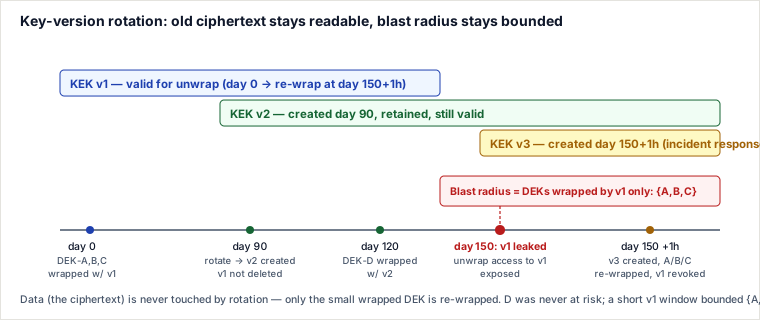
The fix is key versioning: every wrapped DEK stores which KEK version wrapped it (a small integer alongside the ciphertext, not a secret itself). Rotating the KEK means creating a new version and wrapping new DEKs with it — the KMS retains old versions so unwrap requests for old DEKs still resolve. Nothing about the underlying data is touched; only the small wrapped-DEK blob would need re-wrapping, and even that's optional until you choose to retire the old version.
| Day | Event | What's decryptable, and how |
|---|---|---|
| 0 | KEK v1 active. Secrets A, B, C written; their DEKs wrapped with v1 | A, B, C readable by unwrapping via v1 |
| 90 | Scheduled rotation: KEK v2 created. v1 is retained, not deleted | A, B, C still readable via v1; nothing re-wrapped yet |
| 120 | Secret D is written; its DEK is wrapped with v2 (the now-current version) | D readable via v2; A, B, C unaffected, still on v1 |
| 150 | Incident: an IAM misconfiguration grants an attacker unwrap access to v1 | Blast radius = every DEK ever wrapped under v1 while it was live — {A, B, C} only. D was wrapped under v2 and was never exposed. |
| 150 + 1h | Response: create KEK v3, re-wrap A/B/C's DEKs under v3, revoke the leaked IAM grant on v1 | A, B, C now depend on v3 going forward; any future access via the compromised v1 grant is moot — it no longer maps to anything you rely on |
Two things fall out of this mechanism directly: rotation cost is decoupled from data volume — you re-wrap kilobytes of DEKs, never re-encrypt terabytes of data, so rotation is cheap enough to do routinely; and the blast radius of a leaked key is exactly the set of DEKs wrapped while that version was live, nothing more, nothing less. A shorter rotation window directly bounds that set — rotate every 90 days instead of every 2 years, and a leaked version exposes 90 days' worth of newly-wrapped secrets instead of two years' worth. That is the entire argument for short rotation windows: they're not about the crypto getting weaker over time, they're about capping how much a single compromised version can ever have touched.
5. Config/secrets fan-out back-pressure — the thundering herd
Envelope encryption and a config server both assume instances fetch occasionally. A mass restart — a node-pool upgrade, an autoscaling event, a region failover — breaks that assumption: every pod comes up cold at roughly the same instant and each one needs to git-pull its config and perform a Vault login plus one or more KMS Decrypt calls to unwrap its secrets before it can serve traffic.
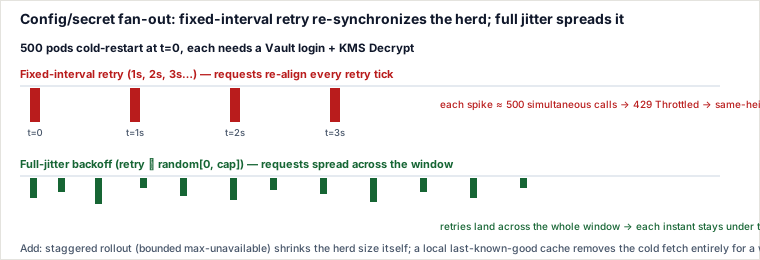
Worked numbers. A cluster-wide event (e.g. a node-pool upgrade) triggers 500 pods to cold-start within about 1 second of each other. Each does a Vault login (a token exchange) plus 3 KMS Decrypt calls to unwrap its secrets — 1,500 concurrent Decrypt calls against a KMS account quota of, say, 1,000 requests/second. A third of those calls come back ThrottlingException. If every client retries on a fixed interval (1s, 2s, 3s…), the failed third re-issues at exactly t+1s, colliding with whatever else was scheduled for that instant — the retries re-synchronize the herd instead of dispersing it, and the spike can persist for several rounds while pods that can't complete startup sit crash-looping.
The standard defenses, layered:
- Full-jitter exponential backoff — each retry waits a random duration up to a growing cap, not a fixed one, so 500 synchronized failures spread themselves across the whole backoff window instead of re-aligning every second.
- Staggered/rolling rollout — cap how many instances restart concurrently (e.g. a
maxUnavailableof 10%), which shrinks the herd itself: 500 simultaneous cold starts becomes a trickle of 50 at a time. - Local caching / last-known-good — a sidecar or client library that keeps the last successfully resolved config and secrets on local disk so a restart can serve from cache while it retries the live fetch in the background, rather than blocking startup on it.
Annotation and encryption pitfalls that ride along with this. The moment secrets are being decrypted in-process, they are one careless log statement away from leaking somewhere with a much bigger blast radius than the vault itself — a DEBUG-level config dump or an exception's toString() on a config object can push a decrypted DB password straight into a log aggregator that far more people and tools can read than the secrets store. The fix is to mark sensitive fields explicitly (a @Sensitive annotation or a wrapper type that redacts on toString()/serialization) so this is safe by default, not something every call site has to remember, and to run an automated log-scrubber or secret scanner as a second line of defense.
Pitfalls
- Refreshing a value that's a cross-instance contract, not a scalar. A wire format, schema, or shared resource limit going through hot refresh produces a fleet that's inconsistent by construction, not just briefly stale (§1).
- Treating "push" as instantaneous. Its real worst case is bounded by your reconnect/backoff ceiling after a disconnect, not by its happy-path latency (§3).
- Deleting or disabling an old KEK version right after rotating. Every DEK still wrapped under it instantly becomes undecryptable — re-wrap first, retire second (§4).
- Fixed-interval retry after a throttled config/secrets fetch. It resynchronizes the herd back into the next tick instead of spreading it out (§5).
- Logging a decrypted config object. A DEBUG dump or an exception stack trace is a much wider leak surface than the secrets manager it came from — annotate sensitive fields so redaction is the default.
Judgment layer
Dynamic refresh vs. restart/rolling deploy. Use refresh for drift-tolerant scalars — timeouts, log levels, feature-flag percentages — where any instance holding the old or new value independently is still a valid, working instance. Use a restart or a coordinated multi-phase rollout the moment the value is a contract between instances or components — a wire format, a schema version, a resource pool sized against a shared limit — because there, a mixed-version window isn't tolerable staleness, it's an active defect. The tell: ask "is an instance on the old value, talking to one on the new value, still correct?" If no, it needs a restart-based rollout, not a refresh.
Push vs. pull. Pull when simplicity and predictable server load matter more than shaving seconds off propagation — small-to-medium fleets, and staleness on the order of the poll interval is acceptable. Push/watch when propagation must be sub-second and you can afford to operate a watch-capable store (Consul, etcd) plus the reconnect/resync logic that makes its worst case bounded rather than "usually fast." Never choose push assuming it removes the propagation-latency budget (§3) — it only shrinks the typical case; the tail is still yours to design.
Takeaways
- Dynamic refresh is for drift-tolerant values only. Anything that's a cross-instance contract — wire format, schema, a shared resource limit — needs a coordinated restart or multi-phase rollout; a mixed-version fleet there is the incident, not a symptom of one.
- Push vs pull is a latency/cost trade-off, not a strict upgrade: pull's staleness is bounded by the poll interval and costs everyone's polling load on the server; push is faster on the median but its true worst case is set by your reconnect/backoff policy, not the happy path.
- Envelope encryption only survives key rotation if you version the wrap — record which KEK version wrapped each DEK. That decouples "rotate the master key" from "re-encrypt all data," and a short rotation window is precisely what bounds a leaked key's blast radius to what it wrapped while it was live.
- A mass restart cold-pulling config and secrets from a shared server is a thundering herd. Full-jitter backoff, a staggered rollout, and a local last-known-good cache are the standard defenses — and a decrypted secret must never reach a log line.
Related pages
- The Solution Configuration Externalization Pattern — the basic config-server mechanics this deep dive builds on.
- What Are the Differences Between a Circuit Breaker, Retry With Backoff, and Rate Limiting — the retry/backoff/throttling concepts behind this page's fixed-interval-vs-full-jitter comparison in §5.
- JWT Signing & Key Rotation (HS256 vs RS256, JWKS) — a different concrete instance of key rotation, complementing this page's KEK/DEK versioning scheme.
- Kernel Internals II — Synchronization, Thundering Herd, Zero-Copy, NUMA & Interrupts (Deep Dive) — the same thundering-herd shape at the OS level, one layer below this page's config/secrets fan-out.
- Traffic Amplification: Fan-out & Retry Storms — the retry-storm/back-pressure math that this page's §5 mirrors for config/secrets fan-out.
Re-authored/Deepened for this guide.
🤖 Don't fully get this? Learn it with Claude
Stuck on Config & Secrets Externalization — Dynamic Refresh, Push-vs-Pull, Key Rotation & Fan-out Back-pressure (Deep Dive)? Open Claude, copy a block below, and it'll teach you this exact concept — visually and interactively.
Build the mental picture, not memorization.
I just read a lesson on **Config & Secrets Externalization — Dynamic Refresh, Push-vs-Pull, Key Rotation & Fan-out Back-pressure (Deep Dive)** (System Design) and want to truly understand it. Explain Config & Secrets Externalization — Dynamic Refresh, Push-vs-Pull, Key Rotation & Fan-out Back-pressure (Deep Dive) from first principles using ONE vivid real-world analogy and a visual mental model — draw it as ASCII art or a clear step-by-step diagram — with a concrete example using real numbers. Then ask me one question to check I got the mental picture, and wait for my reply. If you're unsure or a claim isn't standard, say so and reason from first principles instead of guessing.
Socratic — adapts to where you're stuck.
Teach me **Config & Secrets Externalization — Dynamic Refresh, Push-vs-Pull, Key Rotation & Fan-out Back-pressure (Deep Dive)** interactively. Ask me ONE guiding question at a time, wait for my answer, and adapt to my confusion — build the idea with me step by step instead of explaining it all at once. If you're unsure or a claim isn't standard, say so and reason from first principles instead of guessing.
Active recall exposes what you missed.
Quiz me on **Config & Secrets Externalization — Dynamic Refresh, Push-vs-Pull, Key Rotation & Fan-out Back-pressure (Deep Dive)** with 5 questions, easy to tricky, ONE at a time. Tell me if each answer is right; at the end, explain clearly what I got wrong and why. If you're unsure or a claim isn't standard, say so and reason from first principles instead of guessing.
Intuition + hook + flashcards for long-term memory.
Help me remember **Config & Secrets Externalization — Dynamic Refresh, Push-vs-Pull, Key Rotation & Fan-out Back-pressure (Deep Dive)** for the long term: give the one-sentence intuition, a memorable hook/mnemonic, a tiny worked example, and 3 active-recall flashcards (Q -> A). If you're unsure or a claim isn't standard, say so and reason from first principles instead of guessing.