Introduction to the Sidecar Pattern
A sidecar works because a helper process is co-located with your application — in Kubernetes, a second container in the same Pod — so the two share a loopback interface and network namespace, which lets the sidecar transparently intercept every packet the app sends or receives and add cross-cutting behavior (TLS, retries, timeouts, metrics) without the application code knowing it exists.
The mechanism: colocation + traffic interception
The pattern is not just "a helper next to the app." Three physical properties do the actual work:
- Same host / same Pod. The sidecar and app are scheduled together and live and die together. They can reach each other over
127.0.0.1— no service discovery, no cross-network hop, sub-millisecond. - Shared network namespace. In a Kubernetes Pod both containers see the same network stack and the same
iptablesrules. An init container installs REDIRECT rules so that traffic leaving the app is silently rerouted into the sidecar's listener instead of going straight to the wire. - Language-agnostic interception. Because the boundary is the network socket, not a function call, the app can be Java, Go, Python or a 10-year-old binary — the sidecar treats them all identically. That is why the sidecar is the standard way to add polyglot cross-cutting concerns: you implement mTLS/retry/observability once, in one process, and every workload inherits it.
The canonical concrete instance is a proxy sidecar — an Envoy process injected next to each service in a service mesh like Istio or Linkerd. Envoy owns all inbound and outbound TCP for the app and enforces mesh policy on it.
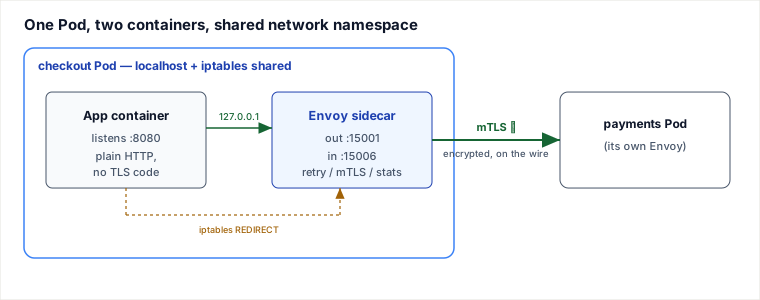
Worked example: one outbound call through an Envoy sidecar
The checkout service calls payments over the mesh. The app makes an ordinary plaintext HTTP call to http://payments:8080/charge; the sidecar does everything else. Route config for payments: timeout 250 ms, 2 retries on 503 with 25 ms backoff, mTLS required. Trace of a single request where the first endpoint returns 503:
| Step | Where | What happens (real values) |
|---|---|---|
| 1 | App container | GET http://payments:8080/charge — plain HTTP, no TLS, ~0.05 ms to loopback. |
| 2 | iptables (shared ns) | REDIRECT rule captures the outbound TCP and rewrites the destination to Envoy's 127.0.0.1:15001. App is unaware. |
| 3 | Envoy (checkout) | Resolves payments cluster → 3 endpoints; load-balances to 10.1.4.7. Starts the 250 ms deadline. |
| 4 | Envoy (checkout) | Originates mTLS with SPIFFE identity spiffe://cluster.local/ns/shop/sa/checkout; encrypts and sends to the payments Pod's Envoy on :15006. |
| 5 | Envoy (payments) | Terminates mTLS, evaluates AuthorizationPolicy (checkout is allowed), forwards plaintext to the payments app on 127.0.0.1:8080. |
| 6 | Envoy (checkout) | Endpoint 10.1.4.7 returns 503. Retry policy fires: wait 25 ms, pick a different endpoint 10.1.4.9. |
| 7 | Envoy (checkout) | Retry returns 200 in 40 ms. Total 65 ms < 250 ms deadline. App sees a clean 200 and never knew a retry happened. |
| 8 | Both Envoys | Emit metrics: istio_requests_total{response_code="200"}, latency histogram, and a distributed-trace span — all without one line of telemetry code in either app. |
The payoff is visible in step 8: mTLS, retry, load balancing, authz and observability were added to a service that contains none of that logic. Swap the Java app for a Go one and the behavior is byte-for-byte identical.
Pitfalls
- Startup ordering race. The app container can start and fire requests before Envoy's listeners are ready → early calls fail with connection-refused. Fix: Istio's
holdApplicationUntilProxyStarts, or Kubernetes native sidecar containers (1.29+, a sidecar declared as an init container withrestartPolicy: Always, which is guaranteed to start first and stop last). - Shutdown ordering. If the sidecar is killed before the app finishes draining, in-flight requests are dropped and you get spurious 5xx during every rolling deploy. Same native-sidecar fix; before that,
preStopsleeps were the ugly workaround. - Jobs / CronJobs never complete. Pre-native-sidecar, a batch Pod would run forever because the long-lived Envoy kept the Pod "Running." Native sidecars finally let the Pod terminate when the main container exits.
- Resource multiplication. Each sidecar costs ~50–150 MB RAM and some CPU. At 5,000 Pods that is hundreds of GB of memory doing nothing but proxying — a real cloud bill. Every request also crosses two extra proxy hops, adding roughly 1–3 ms to p99 per hop.
- iptables capture surprises. Anything that must bypass the mesh (the app talking to the Kubernetes API server, a metadata endpoint, or UDP/DNS quirks) has to be explicitly excluded from redirection, or it silently breaks.
- Upgrade blast radius. Upgrading the sidecar version means redeploying (restarting) every Pod in the mesh. A bad sidecar release is a fleet-wide incident.
When to use it — and when not to
Reach for a sidecar when you have a polyglot fleet and need uniform east-west concerns (mutual TLS, retries, traffic shifting, per-workload identity, golden-signal metrics) that you cannot or will not bake into each service's code — e.g. you must secure a legacy binary you can't recompile, or you run Java + Go + Python and refuse to maintain three copies of the same resilience logic.
Trade-offs vs the named alternatives
- Shared library / in-process SDK (resilience4j, gRPC's built-in retries, an OpenTelemetry SDK). Gain: no extra process, no network hop — lowest latency and memory. Cost: you must reimplement and re-test it in every language, it is coupled to the app's deploy cycle, and you get version fragmentation across teams. Also can't protect a binary you can't rebuild.
- Node-level agent (DaemonSet, one per node) — e.g. a per-node proxy or log shipper. Gain: one instance per node instead of per Pod, so far less memory at scale. Cost: weaker isolation (noisy-neighbor across all Pods on the node), coarser identity (per-node, not per-workload), and a per-node blast radius.
- Centralized proxy / API gateway at the edge. Gain: a single choke point, easy to reason about. Cost: it only governs north-south (ingress) traffic; it does nothing for the service-to-service east-west calls that dominate a microservice system.
Decision rule: choose the sidecar when you need per-workload identity and uniform east-west policy across a polyglot fleet and can absorb the memory/latency tax. Prefer a shared library when it's a single language, a small fleet, and latency is sacred. Prefer a DaemonSet agent when you're memory-constrained at large scale and per-Pod isolation isn't required. Prefer an edge gateway when the concern is purely ingress.
Takeaways
- The mechanism is colocation + a shared network namespace: same Pod,
127.0.0.1, and iptables redirection let a helper intercept traffic transparently — that, not the analogy, is why it works. - Because the boundary is a socket rather than a function call, one sidecar implementation serves any language — the pattern's real superpower for cross-cutting concerns.
- The flagship instance is a proxy sidecar (Envoy) in a service mesh, adding mTLS, retries, load balancing and observability to apps that contain none of it.
- It is not free: budget for ~50–150 MB per Pod, extra hops of latency, and startup/shutdown ordering — use native sidecar containers and weigh a library or DaemonSet before meshing everything.
Re-authored and deepened for this guide. Sources: Istio documentation (sidecar injection, traffic management, mutual TLS); Envoy Proxy architecture docs; Bilgin Ibryam & Roland Huß, Kubernetes Patterns (Sidecar & Ambassador patterns); Microsoft Azure Architecture Center, "Sidecar pattern"; and Kubernetes KEP-753 / native sidecar containers (GA in 1.29). Worked values are illustrative of a standard Istio + Envoy deployment.
🤖 Don't fully get this? Learn it with Claude
Stuck on Introduction to the Sidecar Pattern? Open Claude, copy a block below, and it'll teach you this exact concept — visually and interactively.
Build the mental picture, not memorization.
I just read a lesson on **Introduction to the Sidecar Pattern** (System Design) and want to truly understand it. Explain Introduction to the Sidecar Pattern from first principles using ONE vivid real-world analogy and a visual mental model — draw it as ASCII art or a clear step-by-step diagram — with a concrete example using real numbers. Then ask me one question to check I got the mental picture, and wait for my reply. If you're unsure or a claim isn't standard, say so and reason from first principles instead of guessing.
Socratic — adapts to where you're stuck.
Teach me **Introduction to the Sidecar Pattern** interactively. Ask me ONE guiding question at a time, wait for my answer, and adapt to my confusion — build the idea with me step by step instead of explaining it all at once. If you're unsure or a claim isn't standard, say so and reason from first principles instead of guessing.
Active recall exposes what you missed.
Quiz me on **Introduction to the Sidecar Pattern** with 5 questions, easy to tricky, ONE at a time. Tell me if each answer is right; at the end, explain clearly what I got wrong and why. If you're unsure or a claim isn't standard, say so and reason from first principles instead of guessing.
Intuition + hook + flashcards for long-term memory.
Help me remember **Introduction to the Sidecar Pattern** for the long term: give the one-sentence intuition, a memorable hook/mnemonic, a tiny worked example, and 3 active-recall flashcards (Q -> A). If you're unsure or a claim isn't standard, say so and reason from first principles instead of guessing.