The Architecture
A bulkhead works by giving each downstream dependency its own fixed slice of a finite resource — a dedicated thread pool or a fixed set of semaphore permits — so that when one dependency slows down, only its slice fills up and callers to it fail fast, while the other slices' capacity is physically unreachable to it and keeps serving.
Everything else on this page is a consequence of that one sentence. The name comes from ships: a hull divided into watertight compartments so that a breach floods one compartment instead of sinking the vessel. In software the "water" is concurrency demand, and the compartment walls are pool boundaries.
Why an un-partitioned service dies: a traced collapse
Consider a storefront service backed by a single 200-thread Tomcat pool. It calls three dependencies. The governing law is Little's Law: concurrency = arrival rate × latency (L = λ × W). That is the whole mechanism — hold it in your head as we trace the failure.
- Steady state. Payments: 20 req/s × 100 ms = 2 threads. Inventory: 30 req/s × 50 ms = 1.5 threads. Recommendations: 50 req/s × 200 ms = 10 threads. About 14 of 200 threads busy. Comfortable.
- The recommendations backend GC-pauses. Its p99 latency jumps from 200 ms to 5000 ms. Nothing else changed.
- Little's Law re-prices it. Recommendations now demands 50 req/s × 5 s = 250 threads to keep up. Requests keep arriving; recs threads accumulate because each one is parked waiting on a slow socket read.
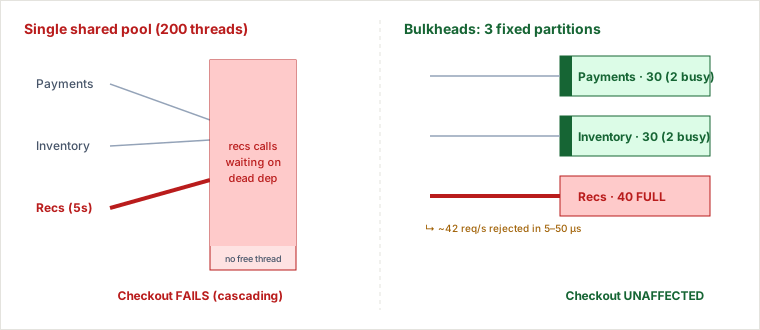
- Within ~4 seconds the shared 200-thread pool is fully occupied by recommendation calls blocked on a half-dead dependency.
- Payments and Inventory requests arrive and find no free thread. They queue, then time out. Checkout starts failing. A non-critical "you may also like" widget has taken down payments. That is a cascading failure, and it is the default behavior of any service with one shared pool.
The same failure, contained
Now partition the 200 threads into three bulkheads. The critical arithmetic: the sum of the slices should sit below total capacity, leaving headroom. Here 30 + 30 + 40 = 100 ≤ 200. When the recommendations backend degrades to 5 s again, the numbers play out completely differently:
| Dependency | Pool size | Queue | Demand at 5 s latency | In flight | Rejected | Healthy? |
|---|---|---|---|---|---|---|
| Payments | 30 | 0 | normal (2) | 2 | 0 | yes |
| Inventory | 30 | 0 | normal (1.5) | 2 | 0 | yes |
| Recommendations | 40 | 10 | 250 threads | 40 (+10 queued) | ~42 req/s, fail fast | contained |
Recommendations can now only serve 40 threads ÷ 5 s = 8 req/s. The other ~42 req/s hit a full pool and get a BulkheadFullException in 5–50 µs — the widget renders "recommendations unavailable" instead of hanging. Crucially, Payments and Inventory each still have their own 30 threads that recommendations cannot touch. Checkout is unaffected. The breach flooded one compartment.
Pitfalls
- The isolation is an illusion if the pools share a downstream. Two thread pools that both open connections against the same 20-connection Postgres pool are not isolated at the level that matters — the DB pool is the real bulkhead. Partition the scarcest shared resource, not just the threads in front of it.
- Semaphore bulkheads cannot interrupt a hung call. A semaphore-based bulkhead runs the call on the caller's own thread; it caps concurrency but has no separate thread to abandon, so a socket read stuck for 30 s still ties up that caller thread for 30 s. Only a thread-pool bulkhead can enforce a timeout by walking away from the worker.
- Over-partitioning wastes capacity. Splitting 200 threads into twenty 10-thread pools destroys statistical multiplexing: a normal burst to one dependency that a shared pool would absorb now overflows a tiny dedicated pool and rejects healthy traffic. Fewer, well-sized bulkheads beat many tiny ones.
- A large queue silently re-creates the cascade. A bulkhead with a 500-item queue does not fail fast — it just moves the pile-up from threads to the queue, and queued requests inflate effective latency (queue wait + service time). Keep queues short (single digits) so "full" means "reject now."
- Thread-pool bulkheads drop thread-locals. Executing on a pool thread loses the caller's
ThreadLocalcontext — security principal, MDC trace IDs, transaction context. You must explicitly propagate them, or auth/logging breaks in subtle ways.
When to use it — and when not to
Reach for a bulkhead when one service fans out to several downstreams with independent failure modes and you have seen (or fear) one slow dependency starving a shared pool. The tell-tale signal: an incident where a low-value dependency's latency spike caused unrelated high-value requests to time out. That is exactly the collapse traced above.
Thread-pool bulkhead vs. semaphore bulkhead
Both cap concurrency. Thread-pool isolation (Netflix Hystrix's default, Resilience4j's ThreadPoolBulkhead) buys you timeout enforcement and true isolation from a blocking call, at the cost of a context switch per call (~microseconds) and ~0.5–1 MB of stack per thread, plus lost thread-locals. Semaphore isolation (Resilience4j's default Bulkhead) is near-free — just an atomic counter, runs inline — but cannot abandon a stuck call. Choose the thread pool when the call is blocking with unpredictable latency (network I/O to a shaky dependency); choose the semaphore for fast in-memory or already-async/non-blocking calls where you want tens of thousands of req/s with no thread overhead.
Bulkhead vs. circuit breaker (they are complements, not rivals)
A bulkhead limits how much concurrency a dependency can consume; a circuit breaker decides whether to call it at all once it looks dead. A bulkhead contains a slow dependency (bounds the damage while it degrades); a circuit breaker contains a dead one (stops wasting even the bulkhead's 40 threads on calls that will fail). Production systems layer them: bulkhead sizes the blast radius, breaker trips when the failure rate inside that radius crosses a threshold. Neither replaces the other.
Bulkhead vs. physical isolation (separate pod/service)
Thread/semaphore bulkheads isolate within one process. If the noisy neighbor hurts you at the CPU or memory or GC level — not just threads — in-process bulkheads share the same heap and cores and will not save you. Prefer deploying the risky dependency's caller as a separate service/pod (a physical bulkhead) when you need OS-level CPU/memory isolation; accept the cost: an extra network hop, a deployment to operate, and no shared in-memory cache. Use in-process bulkheads first because they are a config change, not an architecture change; escalate to physical isolation only when the failure mode proves to be resource contention below the thread level.
Takeaways
- The mechanism is one line of arithmetic: Little's Law says a slow dependency's thread demand explodes (λ × W), so give it a fixed slice it cannot exceed and fail its overflow fast.
- Size slices so their sum is below total capacity, keep queues tiny, and partition the scarcest shared resource (often the DB connection pool), not just the front-end threads.
- Thread-pool isolation enforces timeouts but costs threads and thread-locals; semaphore isolation is cheap but cannot interrupt a hung call.
- Bulkhead contains the slow, circuit breaker contains the dead, physical isolation contains CPU/memory noisy neighbors — layer them by the failure mode you actually observe.
Re-authored and deepened for this guide. Sources: Michael Nygard, Release It! (2nd ed.), the Bulkhead and Circuit Breaker stability patterns; the Netflix Hystrix wiki (thread-pool vs. semaphore isolation and their trade-offs); the Resilience4j documentation (Bulkhead and ThreadPoolBulkhead); and Little's Law (L = λW) for the concurrency arithmetic. Numbers in the worked example are illustrative but internally consistent.
🤖 Don't fully get this? Learn it with Claude
Stuck on The Architecture? Open Claude, copy a block below, and it'll teach you this exact concept — visually and interactively.
Build the mental picture, not memorization.
I just read a lesson on **The Architecture** (System Design) and want to truly understand it. Explain The Architecture from first principles using ONE vivid real-world analogy and a visual mental model — draw it as ASCII art or a clear step-by-step diagram — with a concrete example using real numbers. Then ask me one question to check I got the mental picture, and wait for my reply. If you're unsure or a claim isn't standard, say so and reason from first principles instead of guessing.
Socratic — adapts to where you're stuck.
Teach me **The Architecture** interactively. Ask me ONE guiding question at a time, wait for my answer, and adapt to my confusion — build the idea with me step by step instead of explaining it all at once. If you're unsure or a claim isn't standard, say so and reason from first principles instead of guessing.
Active recall exposes what you missed.
Quiz me on **The Architecture** with 5 questions, easy to tricky, ONE at a time. Tell me if each answer is right; at the end, explain clearly what I got wrong and why. If you're unsure or a claim isn't standard, say so and reason from first principles instead of guessing.
Intuition + hook + flashcards for long-term memory.
Help me remember **The Architecture** for the long term: give the one-sentence intuition, a memorable hook/mnemonic, a tiny worked example, and 3 active-recall flashcards (Q -> A). If you're unsure or a claim isn't standard, say so and reason from first principles instead of guessing.