Sidecar Pattern Bringing Theory to Practice with an Example
A sidecar works because a second container is scheduled into the same Kubernetes Pod as your application, so both containers share one network namespace — they reach each other on localhost — and a set of iptables rules inside the Pod can silently redirect the app's inbound and outbound traffic through the sidecar, letting it add TLS, retries, and telemetry without the application knowing the sidecar exists.
That last clause is the whole point, and it is exactly what a naive example gets wrong. The previous version of this page said the sidecar and the app must live "within the same container" and then had the app make an explicit HTTP call to the sidecar. Both are wrong, and correcting them is how you actually understand the pattern.
The two things everyone gets wrong
1. Same Pod, not same container
A container is a single process tree with its own filesystem. If you jam two programs into one container you have thrown away independent images, independent restarts, independent resource limits, and independent CVE patching — every reason to split them in the first place. The correct unit is the Pod: two (or more) containers, each with its own image and lifecycle, that Kubernetes always schedules together on the same node and that share the Pod's network namespace and (optionally) volumes. "Deploy them in the same Pod" is right; "same container" is not.
2. The app should not call the sidecar — the sidecar intercepts the app
The old example had getData() do a blocking RestTemplate.getForEntity("http://localhost:8081/log", ...) on every request. That is the app reaching out to a helper. It contradicts the promise from the previous lesson that the sidecar "intercepts all incoming and outgoing traffic," and it defeats the pattern: the app now hard-codes the sidecar's port, blocks on it, and fails if it is down. Real traffic-interception sidecars (Envoy under Istio/Linkerd) require zero application changes.
Two legitimate flavors — know which one you mean
| Flavor | How the app reaches it | App aware? | Examples |
|---|---|---|---|
| Transparent proxy (traffic interception) | iptables redirect; app talks to normal ports and the packets are rerouted underneath it | No — unmodified | Envoy in Istio/Linkerd: mTLS, retries, load balancing, tracing |
| Helper / utility | App writes to a shared volume or emits to a well-known local endpoint; sidecar consumes asynchronously | Slightly — agrees on a file/socket, not on request-path calls | Log shipper (Fluent Bit tailing a shared log dir), config reloader, secret fetcher |
The previous lesson described the proxy flavor ("intercepts all traffic"), so the worked example below is a proxy. The helper flavor is real too — but even it does not put a synchronous call on the app's hot path.
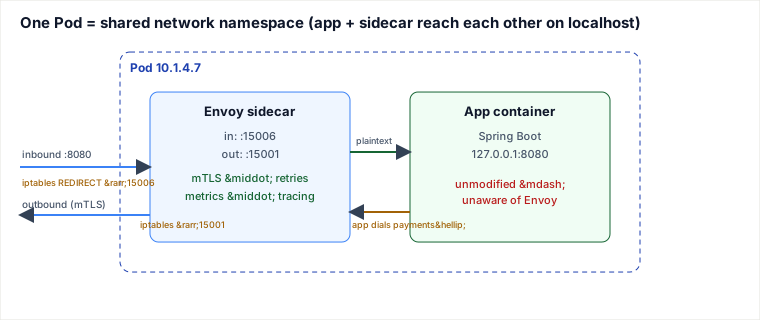
The app you deploy is boring on purpose
Because interception happens below the app, the Java service is the original, unmodified version — no RestTemplate, no knowledge of a sidecar. That is the feature, not a shortcut:
@SpringBootApplication
@RestController
public class MainApplication {

    public static void main(String[] args) {
        SpringApplication.run(MainApplication.class, args);
    }

    @GetMapping("/api")
    public String getData() {
        return "Hello, Sidecar!";   // no sidecar call anywhere
    }
}
All the sidecar wiring lives in the Pod spec and in iptables, which the mesh's init-container installs automatically:
# The two containers share the Pod's network namespace.
apiVersion: v1
kind: Pod
metadata:
  name: orders
spec:
  containers:
    - name: app                     # your unmodified image
      image: orders:1.0
      ports: [{ containerPort: 8080 }]
    - name: istio-proxy             # the Envoy sidecar
      image: envoyproxy/envoy
      ports: [{ containerPort: 15006 }, { containerPort: 15001 }]

# What the init-container installs (simplified):
# redirect everything ARRIVING at the Pod into Envoy's inbound port
iptables -t nat -A PREROUTING  -p tcp -j REDIRECT --to-port 15006
# redirect everything the app SENDS OUT into Envoy's outbound port
iptables -t nat -A OUTPUT      -p tcp -j REDIRECT --to-port 15001
Why the naive version is wrong: the old code baked http://localhost:8081/log and a blocking call into getData(). That couples the app to the sidecar's port, adds a synchronous round-trip to every request, and makes /api fail when the logger is down — a helper that was supposed to be invisible now sits on your critical path. If you truly want a logging helper, have the app write to a file in a shared emptyDir volume and let a Fluent Bit sidecar tail it asynchronously; the request path never touches the sidecar.
Worked trace: one request through the proxy
Client Pod calls GET http://orders:8080/api. Watch where the app's port (8080) is quietly bent to Envoy's (15006).
| # | Where | What happens | Concrete value |
|---|---|---|---|
| 1 | Caller's Envoy | Opens mTLS connection to Orders Pod IP | → 10.1.4.7:8080 |
| 2 | Orders Pod, kernel | PREROUTING rule rewrites destination before app sees it | 8080 → 15006 |
| 3 | Envoy :15006 | Terminates mTLS, checks AuthorizationPolicy, records istio_requests_total, emits span | allow; +1 metric |
| 4 | Envoy → app | Forwards plaintext over loopback | → 127.0.0.1:8080 |
| 5 | Spring Boot | getData() returns the string | 200, body "Hello, Sidecar!" (15 B) |
| 6 | Envoy (return) | Records response code/latency, re-encrypts | code=200, dur=2ms |
| 7 | Caller | Receives 200 over mTLS — unaware two proxies were in the path | total +0.3–1.2ms/hop |
Nowhere in steps 1–7 did the application call anything. Interception, not invocation, is the mechanism.
Pitfalls
- Startup/shutdown races. Before native sidecars (Kubernetes 1.29
initContainerswithrestartPolicy: Always, KEP-753), the app could start before Envoy was ready and its first outbound calls failed, or the app kept serving after Envoy died. If your app makes calls at boot (DB migration, config fetch), you must order the sidecar first. - The Pod never fully exits. A batch/Job Pod finishes its work but the Envoy container runs forever, so the Job never reports Complete. Classic symptom of forgetting sidecar termination handling.
- Resource doubling. Every Pod now carries an Envoy (~50–150 MB RAM, a fraction of a core). At 2,000 Pods that is real money and real scheduling pressure — the tax is per-Pod, not per-service.
- Silent traffic that skips the mesh. UDP, or ports excluded from the iptables capture, bypass Envoy — so you think you have mTLS everywhere but a metrics port is plaintext.
- Debugging gets a new layer. A 503 might be the app, or Envoy's retry/circuit-breaker/outlier-detection. You now read two access logs per hop.
When to use it — and when not to
Reach for a sidecar (mesh) when: you have a polyglot fleet (Java, Go, Node) that all need the same cross-cutting behavior — mTLS, retries, uniform tracing, traffic-shifting for canaries — and a platform team wants to own that policy centrally without asking every app team to add a library and redeploy. The bigger and more heterogeneous the fleet, the more the sidecar pays off.
Do not reach for it for a single service or a monolith, for latency-critical hot paths where an extra proxy hop and its CPU are unacceptable, or for a small single-language team where a library is simply cheaper to run and reason about.
Trade-offs vs named alternatives
- vs in-process library (Resilience4j, gRPC interceptors, OpenTelemetry SDK): the library has zero extra hop and the lowest latency, and it is trivial to debug — but it is per-language, ships inside the app so a policy change means redeploying every service, and drifts across versions. The sidecar buys language-independence and central control at the cost of latency and per-Pod RAM/CPU.
- vs API gateway / edge proxy: a gateway centralizes concerns at the edge (one place to manage) but does nothing for east-west service-to-service traffic and is a shared choke point. Sidecars secure and observe every internal hop.
- vs eBPF / ambient mesh (Cilium, Istio ambient): moves L4 work into the kernel with no per-Pod proxy, cutting the resource tax — but L7 features are less mature/flexible than a full Envoy per Pod.
Choose the sidecar when you need uniform L7 policy across a large polyglot fleet you cannot or will not modify. Prefer an in-process library when you are single-language, latency-sensitive, and small enough that per-Pod proxies are pure overhead.
Takeaways
- Same Pod, separate containers — "same container" is the error to unlearn; the Pod is what makes
localhostand shared volumes work. - A proxy sidecar intercepts via iptables and the shared network namespace; the app is unmodified and never calls it. A synchronous app→sidecar call is not this pattern.
- Two valid flavors: transparent proxy (mesh) and async helper (log shipper via shared volume). Neither puts the sidecar on the app's synchronous hot path by design.
- The bill is real and per-Pod: +0.3–1.2 ms/hop and ~50–150 MB RAM each. Worth it for a large polyglot fleet; wasteful for one service — use a library there.
Re-authored and deepened for this guide. Sources: Kubernetes documentation (Pods, and native sidecar containers, KEP-753); Istio architecture and traffic-management docs (sidecar injection, iptables redirection to Envoy ports 15001/15006); Envoy proxy documentation; Bilgin Ibryam & Roland Huß, Kubernetes Patterns (Sidecar and Adapter/Ambassador patterns); Microsoft Azure Architecture Center, "Sidecar pattern." The original page's "same container" claim and its RestTemplate-to-sidecar example were corrected here.
🤖 Don't fully get this? Learn it with Claude
Stuck on Sidecar Pattern Bringing Theory to Practice with an Example? Open Claude, copy a block below, and it'll teach you this exact concept — visually and interactively.
Build the mental picture, not memorization.
I just read a lesson on **Sidecar Pattern Bringing Theory to Practice with an Example** (System Design) and want to truly understand it. Explain Sidecar Pattern Bringing Theory to Practice with an Example from first principles using ONE vivid real-world analogy and a visual mental model — draw it as ASCII art or a clear step-by-step diagram — with a concrete example using real numbers. Then ask me one question to check I got the mental picture, and wait for my reply. If you're unsure or a claim isn't standard, say so and reason from first principles instead of guessing.
Socratic — adapts to where you're stuck.
Teach me **Sidecar Pattern Bringing Theory to Practice with an Example** interactively. Ask me ONE guiding question at a time, wait for my answer, and adapt to my confusion — build the idea with me step by step instead of explaining it all at once. If you're unsure or a claim isn't standard, say so and reason from first principles instead of guessing.
Active recall exposes what you missed.
Quiz me on **Sidecar Pattern Bringing Theory to Practice with an Example** with 5 questions, easy to tricky, ONE at a time. Tell me if each answer is right; at the end, explain clearly what I got wrong and why. If you're unsure or a claim isn't standard, say so and reason from first principles instead of guessing.
Intuition + hook + flashcards for long-term memory.
Help me remember **Sidecar Pattern Bringing Theory to Practice with an Example** for the long term: give the one-sentence intuition, a memorable hook/mnemonic, a tiny worked example, and 3 active-recall flashcards (Q -> A). If you're unsure or a claim isn't standard, say so and reason from first principles instead of guessing.