System Design Examples Bringing the Sidecar Pattern to Life
A sidecar works because it shares the main container's network namespace and lifecycle inside the same pod, so a cross-cutting concern (TLS, retries, metrics, auth) can be intercepted at 127.0.0.1 without the application ever calling it or knowing it exists. That last clause is the whole trick, and it is exactly what most explanations skip: the app makes an ordinary connect() to reviews:9080; something silently reroutes that packet to a proxy in the same pod first. In Istio that "something" is iptables, and Envoy is the sidecar.
The catalogue: four concerns, one shape
The reason the same pattern keeps reappearing is that all four of these are infrastructure code that must run next to every instance but should not live inside it:
| Concern | What the sidecar does | Real example |
|---|---|---|
| Networking | mTLS, load balancing, retries, circuit breaking, traffic splitting | Istio's Envoy proxy |
| Observability / metrics | Emits request-level RED metrics (rate, errors, duration) the app never instrumented | Envoy exposes Prometheus metrics on :15090 |
| Logging | Tails the app's log stream and ships it onward | A per-pod Fluent Bit / Vector sidecar (note: often better as a node agent — see trade-offs) |
| Security / auth | Terminates TLS, validates JWTs / SPIFFE identities, enforces authz policy | Envoy validates the peer cert spiffe://cluster.local/ns/default/sa/bookinfo-productpage |
Istio is the canonical instance: it injects an Envoy container into every meshed pod and gives you all four at once, with zero application changes. The interesting question — the one the fleet-of-ships analogy never answers — is how Envoy sees traffic the app sent to someone else.
The mechanism: iptables redirection inside the pod
When a pod is meshed, an istio-init container (or the Istio CNI plugin) runs before the app and installs iptables rules in the pod's network namespace. Two redirects matter:
- Outbound: the
OUTPUTchain jumps toISTIO_OUTPUT, whichREDIRECTs all outgoing TCP to127.0.0.1:15001(Envoy's outbound listener). - Inbound: the
PREROUTINGchain jumps toISTIO_INBOUND, which redirects incoming TCP to127.0.0.1:15006(Envoy's inbound listener).
The rule that makes this not an infinite loop: Envoy runs as UID/GID 1337, and ISTIO_OUTPUT has a -m owner --uid-owner 1337 -j RETURN rule. Envoy's own outbound packets skip the redirect; everyone else's don't. Because the redirect is transparent, Envoy recovers the real intended destination from the socket via SO_ORIGINAL_DST — that is how it knows the app meant reviews:9080 even though the kernel delivered the connection to :15001.
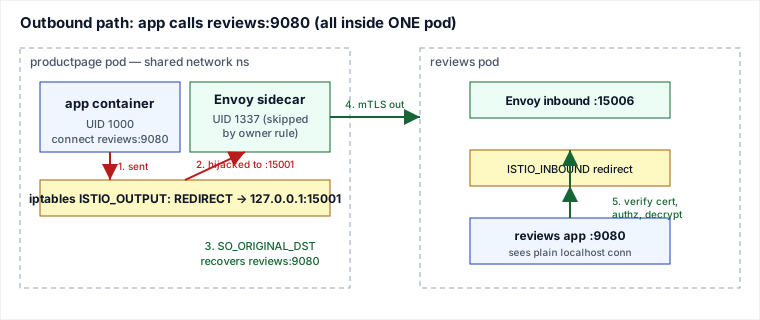
Worked trace: productpage → reviews in the Bookinfo mesh
Concrete addresses: productpage pod 10.1.0.5, reviews pod 10.1.0.8, app port 9080. The app issues GET http://reviews:9080/reviews/0.
- The app process (UID 1000) opens a TCP connection to the reviews ClusterIP for port 9080. The packet enters the local
OUTPUTchain. ISTIO_OUTPUTchecks the owner: not UID 1337, not loopback → jump toISTIO_REDIRECT→REDIRECT --to-ports 15001. The kernel delivers the connection to Envoy at127.0.0.1:15001.- Envoy's
virtualOutboundlistener accepts it, readsSO_ORIGINAL_DST=reviews:9080, matches its route config, and load-balances across the reviews endpoints (say 33/33/33 across v1/v2/v3). It originates mTLS presenting productpage's SPIFFE identity. - The now-encrypted bytes leave the pod to
10.1.0.8:9080over the real network. - On the reviews pod,
PREROUTING→ISTIO_INBOUND→ port 9080 redirected to127.0.0.1:15006. Envoy's inbound listener terminates mTLS, verifies the client cert against its trust bundle, applies anyAuthorizationPolicy, then forwards plaintext to the app on127.0.0.1:9080. - The reviews app receives what looks like an ordinary localhost request. It never configured TLS, never parsed a JWT, never emitted a metric — yet the call was encrypted, authenticated, load-balanced, and counted. The response retraces the path in reverse.
Every capability in the catalogue rode on that one iptables redirect. No line of application code changed.
Pitfalls
- Startup race. If the app sends traffic before Envoy is ready, iptables still redirects it to
:15001— which nothing is listening on yet — so the app getsconnection refused. Fix:holdApplicationUntilProxyStarts, or Kubernetes 1.28+ native sidecars (init containers withrestartPolicy: Always) that guarantee ordering. - Shutdown race & Jobs that never finish. On pod termination Envoy may die before the app, killing in-flight requests; and for a
Job/CronJobthe sidecar never exits, so the pod never reachesCompleted. You must signal the proxy to quit (native sidecars solve the Job case). - UID 1337 collision. If your app happens to run as UID 1337, the owner rule
RETURNs its traffic and it silently bypasses the mesh — no mTLS, no policy, and no error to tell you. - Protocol misdetection. Unnamed ports fall back to protocol sniffing, which can stall or mis-route non-HTTP traffic. Name ports explicitly (
http-,grpc-,tcp-) or setappProtocol. - The init container needs
NET_ADMIN/NET_RAWto write iptables — blocked under restrictive PodSecurity. Use the Istio CNI plugin so no per-pod privileged init container is required. - The multiplication tax. One Envoy per pod means ~50–100 MB RAM and extra CPU per pod, plus roughly two extra proxy hops of p99 latency per request. At 10,000 pods that is 10,000 proxies to run, patch, and pay for.
When to use it — and when not to
The sidecar buys you language-agnostic, per-workload infrastructure with strong isolation, at the cost of one extra process (and its memory + latency) beside every instance. Weigh it against three named alternatives:
| Approach | You gain | You pay |
|---|---|---|
| Sidecar (Envoy per pod) | Polyglot support, per-pod L7 policy & identity, incremental adoption, blast-radius isolation | ~1 proxy/pod RAM+CPU, +latency hops, injection & lifecycle complexity |
| In-process library (gRPC built-ins, Resilience4j) | No extra hop, lowest latency, no infra to run | Per-language reimplementation, coupled to app deploys/upgrades, no isolation |
| Node agent / DaemonSet (Fluent Bit, node exporter) | One process per node, not per pod → huge resource savings for node-shared concerns | Weaker isolation, noisy-neighbor, coarser per-workload policy |
| Ambient mesh (Istio ztunnel per node + optional waypoint) | mTLS/L4 with no per-pod proxy; mesh upgrades decoupled from app restarts | L7 features need a separate waypoint; newer, more moving parts |
Choose the sidecar when you need rich per-workload L7 behaviour (retries, traffic-splitting, per-service authz) across a polyglot fleet you can't force onto one library, and you can afford one proxy per pod. Prefer a library when it's a single language, the path is latency-critical, and the fleet is small. Prefer a DaemonSet when the concern is genuinely node-shared — log shipping and node metrics do not need a copy per pod. Prefer ambient mesh when the per-pod proxy tax dominates your bill and L4 mTLS (plus a few waypoints) covers your needs.
Takeaways
- The sidecar's power comes from sharing the pod's network namespace + lifecycle, letting infra intercept traffic at
localhostwith zero app changes. - Istio's Envoy captures traffic via iptables REDIRECT to ports
15001(out) /15006(in), avoids a loop by exempting UID1337, and recovers the real destination withSO_ORIGINAL_DST. - The dominant cost is multiplication: one proxy per pod in RAM, CPU, and latency — which is exactly why node agents and ambient meshes exist.
- Decide by matching the concern's scope to the deployment unit: per-workload L7 → sidecar; node-shared → DaemonSet; L4-at-scale → ambient; single-language hot path → library.
Re-authored and deepened for this guide. Sources: Istio documentation — Traffic Management and the sidecar-injection / istio-iptables internals; Envoy documentation on original_dst listeners and SO_ORIGINAL_DST; the Istio Bookinfo sample application; Kubernetes documentation on native sidecar containers (KEP-753, 1.28+); and the Istio Ambient Mesh design notes for the sidecar-less comparison.
🤖 Don't fully get this? Learn it with Claude
Stuck on System Design Examples Bringing the Sidecar Pattern to Life? Open Claude, copy a block below, and it'll teach you this exact concept — visually and interactively.
Build the mental picture, not memorization.
I just read a lesson on **System Design Examples Bringing the Sidecar Pattern to Life** (System Design) and want to truly understand it. Explain System Design Examples Bringing the Sidecar Pattern to Life from first principles using ONE vivid real-world analogy and a visual mental model — draw it as ASCII art or a clear step-by-step diagram — with a concrete example using real numbers. Then ask me one question to check I got the mental picture, and wait for my reply. If you're unsure or a claim isn't standard, say so and reason from first principles instead of guessing.
Socratic — adapts to where you're stuck.
Teach me **System Design Examples Bringing the Sidecar Pattern to Life** interactively. Ask me ONE guiding question at a time, wait for my answer, and adapt to my confusion — build the idea with me step by step instead of explaining it all at once. If you're unsure or a claim isn't standard, say so and reason from first principles instead of guessing.
Active recall exposes what you missed.
Quiz me on **System Design Examples Bringing the Sidecar Pattern to Life** with 5 questions, easy to tricky, ONE at a time. Tell me if each answer is right; at the end, explain clearly what I got wrong and why. If you're unsure or a claim isn't standard, say so and reason from first principles instead of guessing.
Intuition + hook + flashcards for long-term memory.
Help me remember **System Design Examples Bringing the Sidecar Pattern to Life** for the long term: give the one-sentence intuition, a memorable hook/mnemonic, a tiny worked example, and 3 active-recall flashcards (Q -> A). If you're unsure or a claim isn't standard, say so and reason from first principles instead of guessing.