The Problem Monolithic Application Management
The Problem: Monolithic Application Management
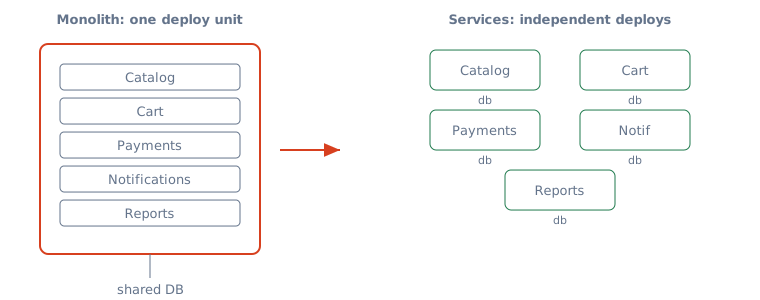
Microservices are an answer, not a starting point. To understand why they exist, you first have to feel the specific pain they were invented to relieve: managing a monolith as it grows. A monolith is a single deployable unit where every feature (login, catalog, cart, payments, notifications) lives in one codebase, compiles into one artifact, and runs as one process talking to one database.
For a small team this is the right choice: one repo, one build, one deploy, easy local setup, and a single call stack you can debug end-to-end. The trouble is not the architecture itself, it is what happens when success arrives, the team grows from 5 to 150 engineers, and the codebase crosses a few hundred thousand lines. The very things that made the monolith pleasant at small scale become the bottleneck at large scale.
How the pain accumulates, precisely
The core issue is that a monolith couples everything along four axes at once, and each becomes a scaling wall:
- Deployment coupling. One artifact means one release train. A one-line change to the notifications email template forces a full rebuild, full regression test, and redeploy of payments and checkout too. Every team's velocity is capped by the slowest, riskiest change in the shared pipeline.
- Build and cognitive coupling. As the codebase grows, build/test times grow super-linearly. A CI run that took 3 minutes at launch takes 45 minutes at scale. No single engineer can hold the whole system in their head, so changes get riskier and code review slows.
- Scaling coupling. You can only scale the whole app, not the hot part. If image processing is CPU-bound and the product catalog is memory-bound, you cannot tune them separately, you replicate the entire monolith and overpay for the resources you did not need.
- Fault coupling. A memory leak or unbounded query in one rarely-used report can exhaust the shared process/connection pool and take down checkout with it. There is no blast-radius containment.
A subtler trap is technology lock-in: the whole app is welded to one language, framework, and runtime version. Upgrading the framework is an all-or-nothing migration, and you cannot adopt a better-fit tool (say, Go for a latency-critical path) without rewriting everything.
A worked scenario with numbers
Consider an e-commerce platform doing 5,000 QPS at peak. The traffic is wildly uneven: catalog browsing is ~4,000 QPS (CPU-light, cache-heavy), checkout/payments is ~200 QPS (latency-critical, must be highly available), and a nightly analytics/reporting job is bursty and memory-hungry.
As a monolith, each instance handles all three. Suppose one instance can serve ~500 QPS before p99 latency degrades, so you run 10 instances to cover 5,000 QPS. Now the analytics job kicks off, allocates huge result sets, and pushes heap usage to 90%. GC pauses spike. Because payments shares the same JVM and the same 100-connection DB pool, checkout p99 jumps from 80 ms to 1,200 ms and some requests time out entirely. A reporting feature just degraded revenue.
The deployment story is just as bad: a hotfix to the payment retry logic requires redeploying all 10 instances of the entire app. The CI pipeline runs the full 40-minute test suite. A rollback means rolling back everyone's unrelated changes merged that day. With services, you would scale catalog to 8 replicas and payments to 2 isolated replicas, cap the report service's memory, and deploy the payment fix in ~3 minutes touching nothing else.
Trade-offs: when the monolith is still right
The senior-engineer insight is that microservices trade internal complexity for operational and organizational complexity, and that trade is only worth it past a certain scale. Do not reflexively decompose.
- Prefer a monolith (or modular monolith) when: the team is small (under ~15-20 engineers), the domain is still being discovered, or traffic is modest. In-process function calls are nanoseconds and always consistent; a network hop between services is milliseconds and can fail, forcing you into retries, timeouts, and eventual consistency. Early on, that tax buys you nothing.
- Prefer microservices when: multiple teams need to deploy independently, distinct components have genuinely different scaling or availability profiles, or you need fault isolation and per-component technology choice. The win is autonomy, not raw performance.
- The under-rated middle ground is the
modular monolith: one deployable artifact, but with strict internal module boundaries (clear interfaces, no cross-module database access). You get most of the organizational clarity and a clean seam to split later, without distributed-systems overhead. Many teams should stop here.
Compared to the alternatives: a monolith optimizes for simplicity and consistency; microservices optimize for independent deployability and isolation; a modular monolith optimizes for a cheap future option to split. Choose based on team topology and scaling asymmetry, not fashion.
Pitfalls an interviewer probes
- "Microservices for a 3-person startup?" A trap. Splitting too early means you pay for service discovery, distributed tracing, network failure handling, and data consistency while still discovering your domain, and boundaries drawn wrong become expensive to move. Answer: start with a modular monolith, split when a real seam and a real scaling/team pressure appears.
- The
distributed monolith. The worst outcome: services that must be deployed together because they are chatty and tightly coupled. You paid the network tax and kept the deployment coupling. Interviewers look for whether you know boundaries must follow business capabilities (bounded contexts), not layers. - Shared database anti-pattern. If your new "services" all read and write the same tables, you have not decoupled anything, a schema change still breaks everyone. True independence requires each service to own its data.
- Underestimating operational cost. Be ready to name what you now must build: an API gateway, service discovery, centralized logging/tracing, and a story for cross-service transactions (sagas, not 2PC). Saying "microservices scale better" without this is a red flag; scaling is not the primary reason, autonomy and isolation are.
Key takeaways
- The monolith is not a mistake, it is the correct default; its pain (deployment, scaling, fault, and technology coupling) only appears at large team and traffic scale.
- Microservices trade simplicity and strong consistency for independent deployability, fault isolation, and per-component scaling, useful when teams and scaling needs diverge, costly otherwise.
- The modular monolith is the pragmatic middle: strict internal boundaries in one artifact, giving you a cheap option to split later without distributed-systems overhead.
- Interview red flags: splitting too early, the shared-database anti-pattern, and the chatty distributed monolith, decompose along business capabilities, and only when the pain is real.
🤖 Don't fully get this? Learn it with Claude
Stuck on The Problem Monolithic Application Management? Open Claude, copy a block below, and it'll teach you this exact concept — visually and interactively.
Build the mental picture, not memorization.
I just read a lesson on **The Problem Monolithic Application Management** (System Design) and want to truly understand it. Explain The Problem Monolithic Application Management from first principles using ONE vivid real-world analogy and a visual mental model — draw it as ASCII art or a clear step-by-step diagram — with a concrete example using real numbers. Then ask me one question to check I got the mental picture, and wait for my reply. If you're unsure or a claim isn't standard, say so and reason from first principles instead of guessing.
Socratic — adapts to where you're stuck.
Teach me **The Problem Monolithic Application Management** interactively. Ask me ONE guiding question at a time, wait for my answer, and adapt to my confusion — build the idea with me step by step instead of explaining it all at once. If you're unsure or a claim isn't standard, say so and reason from first principles instead of guessing.
Active recall exposes what you missed.
Quiz me on **The Problem Monolithic Application Management** with 5 questions, easy to tricky, ONE at a time. Tell me if each answer is right; at the end, explain clearly what I got wrong and why. If you're unsure or a claim isn't standard, say so and reason from first principles instead of guessing.
Intuition + hook + flashcards for long-term memory.
Help me remember **The Problem Monolithic Application Management** for the long term: give the one-sentence intuition, a memorable hook/mnemonic, a tiny worked example, and 3 active-recall flashcards (Q -> A). If you're unsure or a claim isn't standard, say so and reason from first principles instead of guessing.